
The settlement in Blake Lively v. Wayfarer Studios was filed on May 7, 2026. The joint statement committed both sides to “closure” and to “moving forward constructively and in peace, including a respectful environment online.” Seven days later, Bryan Freedman went on TMZ and accused Blake Lively of being “scared to take the witness stand,” called her a liar, and said she “ended up with nothing.”
This is not a legal development. It is a pattern completing itself.
What the Settlement Actually Says
The stipulation and order of dismissal (Dkt. No. 1434) does three things.
First, it dismisses the Lively action with prejudice under Rule 41(a)(1)(A)(ii). The affirmative claims are resolved. Whatever financial terms exist are not on the public docket.
Second, the Wayfarer Parties irrevocably waive any appeal of any orders in the consolidated action, including without limitation the June 2025 dismissal of their countersuit. That dismissal, which rested on fair report privilege, litigation privilege, and failure to state a claim, is now final and unreviewable.
Third, and this is the operative piece, Blake Lively “does not release, and retains all claims, rights, and remedies in connection with her pending Motion for Attorneys’ Fees, Treble Damages and Punitive Damages under California Civil Code Section 47.1.” The 47.1 motion remains pending. Both parties irrevocably waive any appeal from Judge Liman’s determination of it.
Everything else is closed. The 47.1 motion is the only live piece of the litigation.
What Freedman’s Statement Tells You
Freedman’s statement to TMZ is worth reading not for its content but for what it reveals about the defense’s assessment of where the case stood when it settled.
He said: “Part of the reason Blake settled is because she was scared to take the witness stand at trial. She did not want to face cross examination by anyone because that would require her to tell the truth.”
Consider what was waiting for the Wayfarer Parties at trial.
The jury was going to be instructed to presume that Lively engaged in protected activity. The Wayfarer Defendants stipulated to that on April 29, ten days before the settlement (Dkt. No. 1422). The first element of the FEHA retaliation claim was off the table before opening statements.
The jury was going to see the Nathan/Abel text exchange: “you know we can bury anyone. But I can’t write that to him.” The jury was going to see the Sage Steele coordination, in which Sarowitz gave editorial feedback on a video designed to “look organic” and Steele acknowledged she should not “go too much deeper there based on trying to make it look organic / like I don’t have too much insider info.” The jury was going to hear from three expert witnesses: Professor Culotta documenting statistical evidence of coordinated manipulation on TikTok and Reddit, Dr. Mayzlin documenting the sharp shift in online discourse about Lively coinciding with the campaign’s onset, and Professor Humphreys calculating over 176 million online impressions calling Lively a “bully” and “mean girl” with a 30% increase in negative public attitudes between June and September 2024.
The jury was going to see Jed Wallace’s deposition testimony that he “cannot” do upvotes and “wouldn’t know how,” placed side by side with his contemporaneous written communications describing himself “rewriting the McDonalds image metadata” for another client, “suppressing those posts/links/articles,” and needing “to throw a ton of upvotes at the stuff that is rah rah for him… and need to downvote everything else that’s acting as a drag on him as part of our mandate from you and yours.”
The jury was going to learn that Wallace’s “minimal digital capabilities” testimony was contradicted by pitch documents he sent to other prospective clients describing the ability to “[a]ctively sway the algorithm,” “start threads with theories the team approves of,” and execute everything “without fingerprints,” all while being retained by Wayfarer at $30,000 per month.
And the jury was going to hear that since the Film’s release, Lively received “no meaningful or real offers” for acting work, despite the Film opening at number one, a point at which, as industry testimony established, “the phones are ringing off the hook with incoming opportunities.”
That is what the defense was walking into. Freedman’s characterization that “a trial would have exposed her lies” omits the rather significant question of whose lies the trial would have exposed.
The 47.1 Mechanism
The piece that matters going forward is the 47.1 motion, and the appeal waiver that surrounds it.
Section 47.1 of the California Civil Code is a 2024 statute with almost no appellate construction. It creates a privilege for communications regarding sexual harassment, assault, or discrimination made without malice. The pending motion seeks attorneys’ fees, treble damages, and punitive damages based on the Wayfarer Parties’ dismissed countersuit.
The protected-activity stipulation from April 29 is doing significant work here. By conceding that Lively engaged in protected activity, which encompasses a good faith and reasonable belief that she complained of or opposed unlawful harassment, the Wayfarer Parties have functionally conceded the absence of malice. The privilege under 47.1 attaches to communications made “without malice.” A party who has stipulated that the opposing party’s complaints reflected a good faith and reasonable belief has handed over the element that would defeat malice.
The appeal waiver guarantees that whatever Liman rules on 47.1 is final. No Second Circuit review. No published appellate opinion analyzing the statute’s reach, the malice standard, the prevailing-defendant framework, or the constitutionality of the punitive damages component. The district court ruling is the entire public record of what 47.1 means in this dispute.
Defense teams of this caliber do not prospectively waive appeal rights on multi-million dollar exposure without a reason. There are two plausible readings.
The first is that the 47.1 outcome was functionally pre-negotiated within a known range, and the appeal waiver is paper closing a loop both sides already understand. The protected-activity stipulation reduces the variance in that range by locking in malice, making a pre-negotiated framework more workable.
The second is more strategically substantive. A Second Circuit opinion on 47.1 would produce published precedent available to every future plaintiff bringing a claim under the statute. By waiving appeal rights, the Wayfarer Parties ensure they are not the vehicle for circuit-level 47.1 construction. Whatever Liman rules stays at the district court level.
Neither reading supports the characterization that Lively “ended up with nothing.”
The Displacement Pattern
Freedman’s TMZ statement is itself a demonstration of the mechanism Judge Liman identified in the April 2 opinion. The court carefully distinguished between reasonable defensive measures (permissible) and conduct that crosses the line into attacking a complainant’s professional reputation and livelihood (potentially retaliatory). The court found triable issues on whether the Wayfarer Parties’ conduct crossed that line.
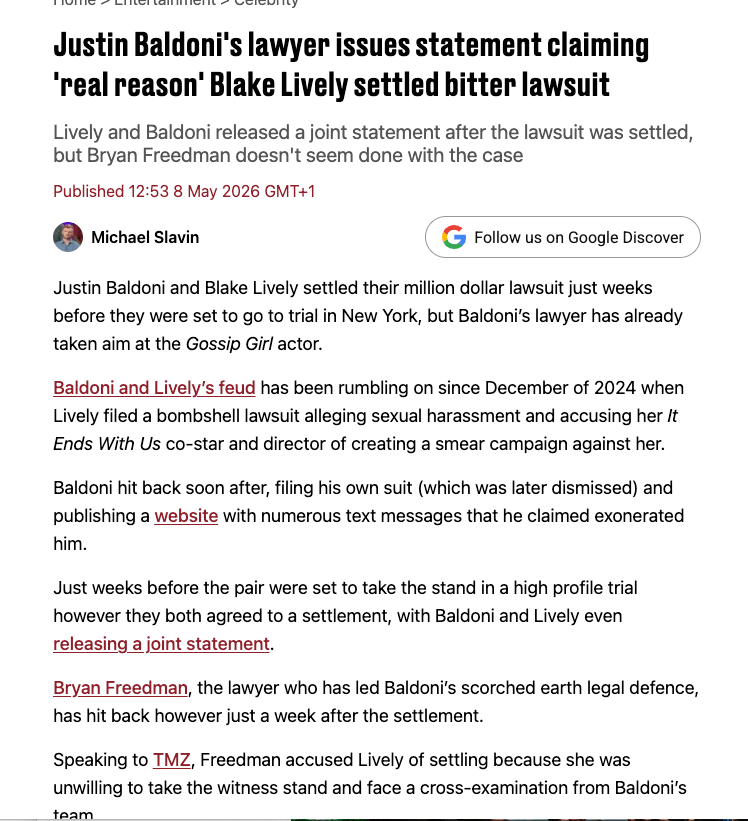
Seven days after a joint statement committing to “closure” and “moving forward constructively and in peace,” Freedman went on camera and accused the settling party of being a coward who was “scared” to testify and a liar whose claims would have been “exposed.” This is not a reasonable defensive measure. It is not a fair report of a judicial proceeding. It is a continuation of the same communications strategy that formed the basis of the surviving retaliation claim, executed after the settlement was signed, against the explicit language of the joint statement the parties issued together.
Lively’s counsel responded with one sentence: “I guess he’s no longer ‘ecstatic’ about the settlement.”
The response is calibrated. It does not engage with the substance of Freedman’s accusations. It simply points to the contradiction between his client’s joint statement and his own public conduct. The legal term for what Lively’s team is doing is letting the record speak for itself. The record includes a joint statement about peace and a lawyer who cannot stop waging war.
The 47.1 ruling will land within roughly thirty to ninety days. When it does, the reporting around it will be processed through the same binary framing that has characterized every procedural development in this case. It will be reported as a verdict on whether Lively was telling the truth about the harassment, when the statute is structurally not designed to answer that question. It will be reported as Lively winning or Baldoni losing, when the motion adjudicates the privileged status of her communications, not the underlying conduct.
The appeal waiver ensures no later corrective. Whatever the press makes of the ruling is, for purposes of the public narrative, what the ruling means.
That is worth tracking when it drops.

