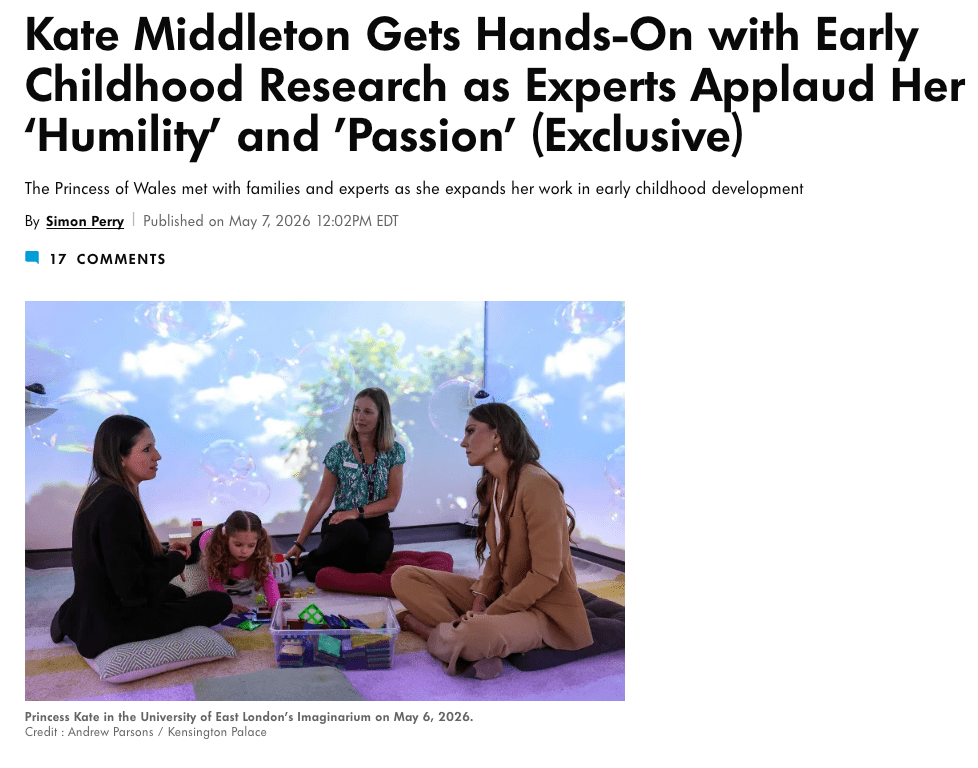
There is a sentence in the People exclusive about Kate Middleton’s University of East London visit that does more analytical work than its author likely intended. It comes from Professor Sam Wass, who heads the university’s Institute for the Science of Early Years and Youth, and it is offered as praise:
“She was really humble. She was interested in finding out the boundaries of scientific knowledge, what we do know and what we don’t, and in using herself as a mouthpiece to help communicate that.”
Professor Wass admitted it: “It’s a funny gift, the gift of publicity.” Kate gets credentialed as humble and keen. His institute gets international press within the hour. Two academics, identical talking points, zero substance about a decade of Early Years work. The trade is the story.
Mouthpiece. Wass volunteered the word. He meant it approvingly. Strip the affective framing, the humility and the openness and the curiosity, and what remains is a credentialed expert describing the Princess of Wales as a vehicle for repeating other people’s expertise. That is the actual function being praised. The article spends roughly twelve hundred words dressing it up.
The retreat is the story. For more than a decade, palace messaging around Kate’s Early Years work has tried to credential her as a substantive figure. She has been framed in the friendly press as a “data-driven royal expert,” as a “credible expert” on child development, as a thought leader whose insights into nursery schools warranted coverage. Each iteration of that framing collapsed under the weight of the evidence, including a 2023 round of actual early years experts publicly criticizing her awareness campaign as substantively empty. The current cycle has quietly abandoned the expertise claim. What is being credentialed now is disposition. She is humble. She is willing. She is absorbed. She is keen to learn. After fifteen years of marriage to the heir, after the founding of the Royal Foundation Centre for Early Childhood, after task forces and reports and forewords, the most that two named academic sources can offer is that the forty-four-year-old princess sat criss-cross on the floor and listened well.
This is not a failure of the messaging. It is the messaging adapting to what can plausibly be sold.
The mechanics of how the disposition gets credentialed are worth naming clearly. The People piece runs on two named sources, both institutionally entangled with the visit they are quoted assessing. Professor Wass runs the Institute being promoted. Vice-Chancellor Amanda Broderick runs the host university. Both produce affective vocabulary in lockstep, the same register of words, the same approving register, with no friction between them. Humble. Keen. Curious. Open. Absorbed. Passionate. Two independent academics describing a subject’s emotional bearing in identical terms is not independent assessment. It is a coordinated brief. The talking points are no longer about her expertise because that fight was lost. They are about her affect because affect is harder to falsify.
Wass himself names the trade in the same article. “It’s a funny gift, the gift of publicity,” he tells People, describing the international attention his Institute received within an hour of Kate leaving. He is being unusually candid. The exchange is reciprocal. The royal visit produces credentialed praise of the royal. The credentialed institution produces a press cycle for itself. Both parties leave with what they came for. The substantive question of whether Kate’s decade of Early Years activity has produced any measurable outcome for any actual child does not enter the transaction because it is not what the transaction is for.
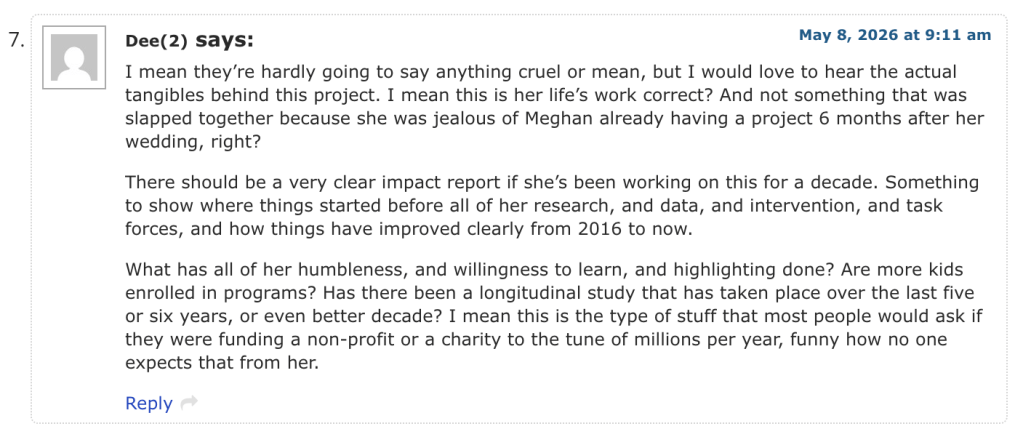
The audience-side response is instructive. The Celebitchy commenter who asked the donor-class question, where is the longitudinal impact data after a decade and millions of pounds, is asking the only question that would meaningfully test the claim being made. That question is structurally absent from the coverage because the coverage is not designed to invite it. A Princess of Wales who must produce evidence of impact is a different product than a Princess of Wales who must produce evidence of humility. The reporting infrastructure that surrounds her has spent years optimizing for the second one.
The example offered as proof of Kate’s “specific” question to researchers, the one Wass himself selects from a presumably larger pool, is a young mother asking how to read a story to a one-year-old while keeping a four-year-old engaged. This is the credentialing example. A woman who has employed multiple nannies asking another woman how to manage two children at once. That this was the question deemed sufficiently substantive to brief to a journalist is the entire argument the piece is unintentionally making.
The mouthpiece said it herself, through the professor she had come to listen to. The boundaries of what we know and what we don’t are real and worth interrogating. What we know is that fifteen years of expert framing has retreated to the claim that she sits on floors well. What we don’t know, and what the coverage is structured to never tell us, is whether any of it has ever been about a child.
Fifteen years ago Kate was a “data-driven royal expert.” Five years ago a “credible expert on child development.” This week, a forty-four-year-old who sat criss-cross on the floor and listened well. The expertise claim collapsed. What’s being credentialed now is disposition, because affect is harder to falsify.

