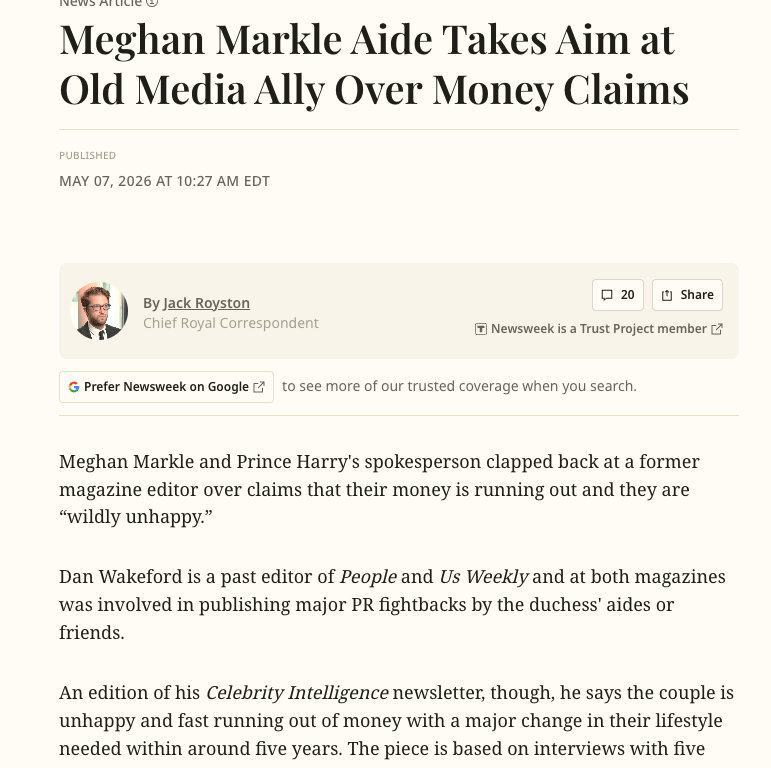
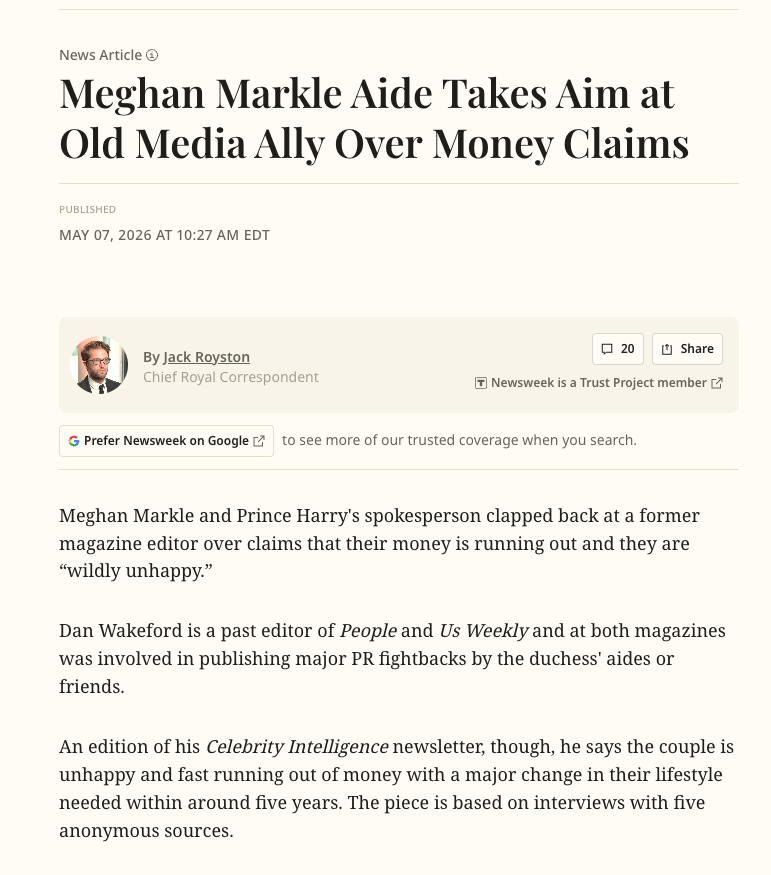
When I mapped the May 1 to May 8 Sussex finance cycle earlier this week, the open question was whether the Sussex camp would respond to it directly or let the cycle burn itself out the way they usually do. On May 7, Newsweek’s Jack Royston published a piece in which a spokesperson for the Duke and Duchess of Sussex did something they have not done with this kind of clarity in a long time. They named the mechanism on the record.
Here is the quote in full.
“The ‘unnamed sources,’ once again, doing a lot of very heavy lifting in this report. If they had any faith or evidence to back up what they allege, I don’t understand why they wouldn’t just go on the record with such claims. Still, I suppose it makes writing a lot easier for Mr. Wakeford when you don’t have an editor standing over you asking you to evidence it or ‘stand it up.'”
Two things are worth attending to here. The first is the target. The spokesperson is not pushing back on the substance of Wakeford’s claims, the dollar figures and the staffing reductions and the security costs. They are pushing back on the structural integrity of the reporting itself. The second is the editor line. “An editor standing over you asking you to evidence it or stand it up” is not throwaway. It is a precise institutional indictment of what Wakeford’s career arc actually represents.
The arc of an ally
Royston’s Newsweek piece does the genuine service of laying out Wakeford’s full history with the Sussex camp, and the timeline is worth recovering because it explains why this particular defection matters more than a generic British tabloid attack would.
Wakeford was the editor of People in February 2019, when Meghan was still a working royal and the British tabloid press was running a sustained campaign against her. The People cover that month featured five of Meghan’s friends defending her on the record, including the reference to the letter she had written to her father. That cover, and the friend who used the word “olive branch” to describe the letter, became the proximate cause of Thomas Markle handing the letter to The Mail on Sunday, which led to the privacy lawsuit Meghan eventually won in 2021. Whatever one thinks of the editorial judgment, Wakeford was inside enough at that moment to land the cover and to be trusted with the framing.
Five years later, in September 2024, Wakeford was the editor of Us Weekly when Mandana Dayani, the former president and chief operating officer of the Archewell Foundation, gave him the cover quote that pushed back against The Hollywood Reporter’s “dictator in high heels” piece. Dayani’s anecdotes about Meghan steaming her own jumpsuit and dancing to oldies in her bedroom were not generated by a journalist with no access. They were given to Wakeford because the Sussex side trusted him to publish them favorably.
Two crisis-moment cover stories, six years apart, both placed with Wakeford because he was the editor the Sussex camp could place them with. That is the relationship Royston is documenting. That is the ally.
What changed
Wakeford no longer edits a magazine. He runs a Beehiiv newsletter called Celebrity Intelligence. The piece that touched off this week’s cycle, headlined “The Truth About Harry and Meghan’s Empire ‘They Are Wildly Unhappy,'” is built on five anonymous sources described as inside the couple’s inner circle. Wakeford does not have an editor at Celebrity Intelligence. He is the editor. He is also the publisher, the sales department, and the legal review.
This is precisely what the Sussex spokesperson is identifying when they invoke “an editor standing over you asking you to evidence it or stand it up.” The institutional check that existed when Wakeford was at People and Us Weekly is gone. The five-source structure that generated his current piece would have required, at a legacy publication, some combination of corroborating documents, on-the-record quotes from at least one of the five, or independent verification of the financial claims. None of that is visible in the newsletter. The reader is asked to trust that five real people exist, that they really said what is attributed to them, and that what they said is accurate.
This is the same Beehiiv-to-Substack pipeline I flagged in the eight-day cycle piece. Failed legacy editors, pushed out of their last institutional homes, recycling each other as sources and laundering anonymous claims through subscriber newsletters that no longer answer to anyone. Wakeford had lunch with Tom Sykes at Pastis in the West Village in early May. Sykes wrote it up for The Royalist on Substack. Wakeford wrote his own version for Celebrity Intelligence on Beehiiv. The same five anonymous sources, or whatever overlapping subset of them, are doing duty across multiple newsletters, each of which then gets multiplied through the wire system into Newsweek, Geo.tv, The New Daily, and the Express.
The Sussex spokesperson’s clapback is the first time, in this cycle, that anyone has pointed at the laundering mechanism with the words it deserves. Heavy lifting. No editor. No evidence. No standing up.
Why the defection registers as defection
Royston’s framing in Newsweek is careful, but the implication is unambiguous. Wakeford is “an example of a significant figure from a U.S. media background, though he is British by birth, who has been willing to publish hugely positive stories about Meghan in the past and is now questioning the couple’s official narrative of Hollywood success.”
What this elides is that Wakeford’s career trajectory tracks a specific institutional shift. When he edited People, he had access, he had a brief from a publication that was friendly to the couple, and his coverage benefited both the publication and the Sussex camp. When he edited Us Weekly, the same dynamic held. When he started a Beehiiv newsletter, the access economics changed. The Sussex camp does not need to place positive cover stories with a subscriber newsletter, because subscriber newsletters do not generate the cultural footprint that magazine covers did. Wakeford’s product, post-Us Weekly, has to find a different audience. That audience is the one that wants to read that the Sussexes are wildly unhappy and running out of money. The supply has adjusted to the demand.
This is not a moral failing unique to Wakeford. It is the structural condition of a former magazine editor monetizing his own newsletter in a market that no longer rewards access journalism the way it once did. The product that pays the rent is the product that runs.
What the response actually accomplishes
The Sussex spokesperson’s statement does three things at once. It declines to engage the specific dollar figures, which would lend them credibility by treating them as worth refuting. It names the structural problem with the reporting in language that is reusable across future cycles. And it identifies Wakeford specifically by name, signaling that the camp has decided this particular relationship is worth ending in public.
Whether the cycle slows is a separate question. The Wakeford newsletter has already done its work. The wire pickups have already happened. The Express has already run its mocking column. The story, in the eyes of the audience that consumed it, has already been told.
What the clapback does is make the next cycle harder. The next time a Wakeford-style piece runs, the clapback exists as text. The phrase “unnamed sources doing a lot of heavy lifting” is now in circulation as a counter-frame. Editors who once would have run the wire pickup without hesitation now have, on the record, the spokesperson identifying the mechanism by which these stories are produced. That does not stop the machinery. It does mark it.
The mouthpiece said it herself, in a different cycle this same week. The unnamed sources said it through Wakeford this week. The spokesperson, finally, said it back.

