Tom Sykes told his Royalist podcast audience that he met somebody in New York who lives near the Sussexes in Montecito, and that this person told him the house is a “laughing stock” because the kitchen “looks straight out of the Olive Garden, circa 1994.” Hello! Magazine’s Rachel Avery wrote that anecdote into a Homes section feature. Yahoo syndicated it with the harder headline “ruffle feathers over ‘shameful’ $29m Montecito mansion.” The Yahoo page collected 964 comments.
This is the part of the production cycle that usually works. The pipeline supplies a prompt, the readers supply the engagement, and the engagement justifies the next prompt. Hostile reader response is the product the pipeline is built to extract. The Sykes-to-Hello!-to-Yahoo handoff is engineered specifically to surface the comment-section content that articles cannot say in their own voice. Grifter, downsize, fraud, go away. That is the labor the article needs the readers to perform.
In this cycle, the readers largely declined.
What the Top Comments Actually Say
The four highest-engagement comments on the Yahoo thread, ranked by likes, read as follows.
Jim, 355 likes: “I’m far from a fan of M & H but it seems they will be criticized no matter what they do.”

AC, 292 likes: “So, the billionaires laugh and look down on them because they have a 20 year old house? Sounds like a really toxic neighborhood. Yuck.”

kl, 273 likes: “They are not billionaires, number one. Number two, we are not going to feel sorry for them because their neighbors think their 29 million dollar house needs a kitchen remodel. Most importantly the American Dream is not to have a multi million dollar home. It’s to have a home, and a reliable job with health insurance with a salary that covers not just the basics but some extras. And a lot of us are finding that out of reach.”

Joe, 176 likes: “Leave them alone please.”

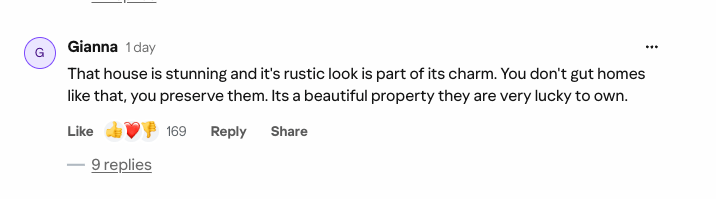


The aggregate sentiment of the most-engaged content on the page is pushback against the article. Not pushback against the Sussexes. Pushback against the framing of the article itself. Jim, who explicitly says he is not a fan, identifies the structural pattern of perpetual criticism. AC reframes the entire premise by pointing out that the people doing the criticizing in the article are anonymous wealthy neighbors looking down on a couple for not being wasteful enough. kl pivots from the manufactured controversy to a real one about what the American dream now means for the people reading.
These are not the responses the production cycle was designed to extract.
The Readers Named the Mechanism Without Help
Several commenters identified the sourcing structure of the article in language that is functionally identical to media criticism written by professional analysts. They did this in two sentences, in casual comment-section prose, without any apparent prompt.
Debbie: “Lol. It’s gossip… a journalist said that someone told him that neighbors said…”

CriticalThinker: “So the article is based on a podcaster who spoke to some random unnamed person who doesn’t like that they didn’t modernize their home. Hmmm… that’s all I’m going to say. I don’t like either H or M but this seems a bit disingenuous.”

Sheila Bielecki: “A friend of a neighbor whose kid goes to school witht the nannies cousin, just stop already.”
MarshaW: “This sounds like a made-up article.”
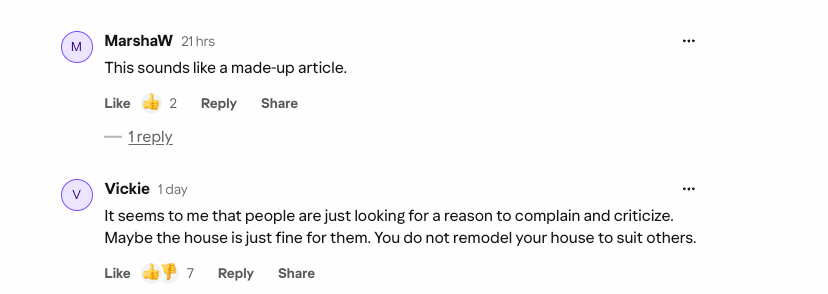
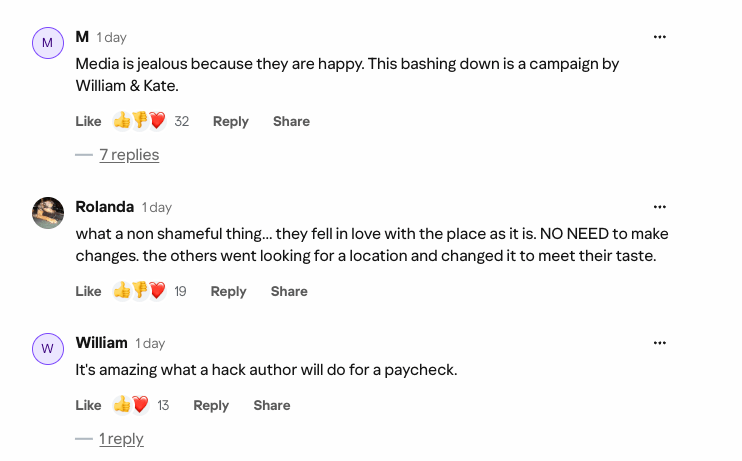
William: “It’s amazing what a hack author will do for a paycheck.”
These commenters did not need an analytical framework explaining opinion laundering or anonymous sourcing or the editor-shaped hole at Beehiiv newsletters. They named the mechanism using the natural skepticism of readers who have seen this structure too many times to be fooled by it again. The “friend of a neighbor whose kid goes to school with the nanny’s cousin” line is, in fifteen words, a more efficient summary of the production pipeline than most academic media-criticism papers produce in thousands.
The CriticalThinker comment is the analytically interesting case. The commenter explicitly says they do not like either Sussex. They are not defending the couple. They are defending the methodology. They have arrived at the article with a hostile prior, encountered the sourcing structure, and concluded that the methodology is too thin to trust even when the conclusion aligns with their priors. That is the readership the pipeline cannot rely on. A reader who refuses the framing even when she agrees with the implicit conclusion is a reader the production cycle cannot use.
The Class Reading Surfaced From the Readers
The kitchen-as-class-marker analysis that media critics typically need to construct as an interpretive overlay appeared in the comment section as a direct reader observation, multiple times.
Ally: “I mean we have seen the kitchen it doesn’t look like Olive Garden from 1994, whether you like them or not, this article comes off as super classist. When avg everyday Americans are struggling buying gasoline who thought writing an article criticizing rich ppl for not being more wasteful and ‘flattening a home to rebuild a new one’ or remodeling a perfectly fine rustic kitchen, would hit the mark with their readers. Weird take.”

Laura: “It is a beautiful home. The story would read, more like how dare they think they can afford and Meghan is out spending herself lavishly, if they decided to redo it. This is the weirdest take. The rich people looking down their noses at other rich people because how dare they live in something that is 20 years old.”

Robert Shiffer: “Maybe they like the rustic look, and they have neighbors who are a bunch of snobs who think they are better than everyone who does not dance to their song.”
JJP: “Sooo shameful to not be wasteful and take all of the history and charm out of their home. Give me a break!”
The class reading is built into the response, not constructed afterward. Ally connects the Sussex story to gasoline prices in two clauses. Laura identifies the no-win structure of the coverage in one sentence. The article asked its readers to side with anonymous wealthy neighbors against a couple whose offense was preserving rather than demolishing. The readers, in significant numbers, noticed that this is a strange ask and refused it.
The Racial Subtext Was Stated by a Reader, Not by an Analyst
Kaye left the longest comment in the visible thread. The full text deserves quoting because no paraphrase improves it.
“Oh, how petty can you get? So some rich people bought a mansion and didn’t even bother to update the kitchen. Wah! What this is really about is looking for any opening to knock a prince who dared to pollute the Royal Genes with African blood. And the fact that it’s the son of beloved blonde & blue Princess Di just makes it even worse. How dare the lily-white son of a White ‘English Rose’ icon dishonor her memory in such a blatant fashion! It wouldn’t make any difference if they bought a shack and updated the whole property, someone would still twist it into an insult. If they lived in a piece of ordinary middle class real estate, they’d be accused of ‘slumming.’ If they had updated the kitchen, they be called ‘spoiled royals’ who were ‘too good’ to live like ‘normal’ people. I get it: people are jealous because a Black woman married someone supposedly beyond her lowly status. Sorry you lost out, but there are only so many princes and not enough to go around.”
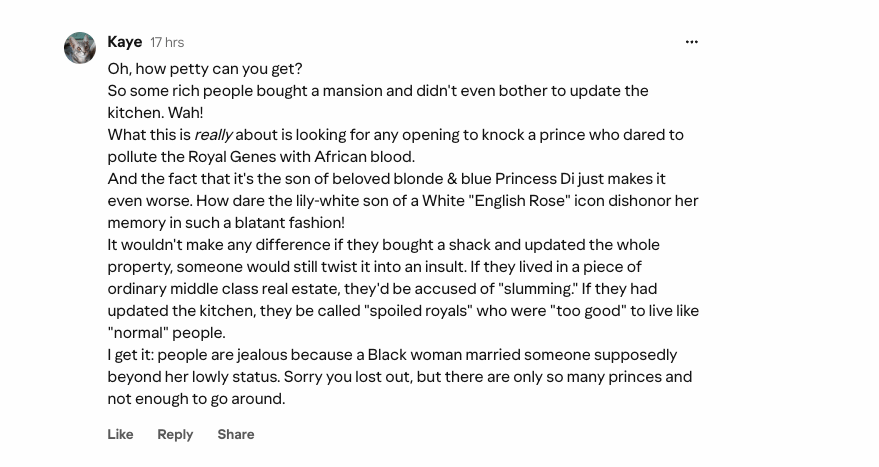
This is the analysis that Caonabo at The Unspun Narrative wrote about the same Hello! article, except produced by a Yahoo commenter without the academic framing or the careful hedging. The same observation, written in casual conversational English, by a reader who absorbed the article and immediately recognized the pattern.
The piece structure permits Kaye to say what the analyst phrases as “class-coded refusal.” Kaye calls it what it is. The royal genes polluted with African blood line is the version of the analysis that the readership delivered in plain text, and the analysis came out of the comment section, not into it.
What Yahoo’s Own AI Noticed
The Yahoo Scout AI summary at the top of the comment section reads as follows.
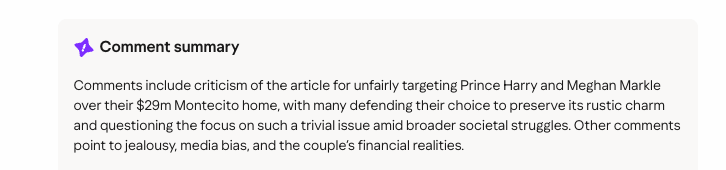
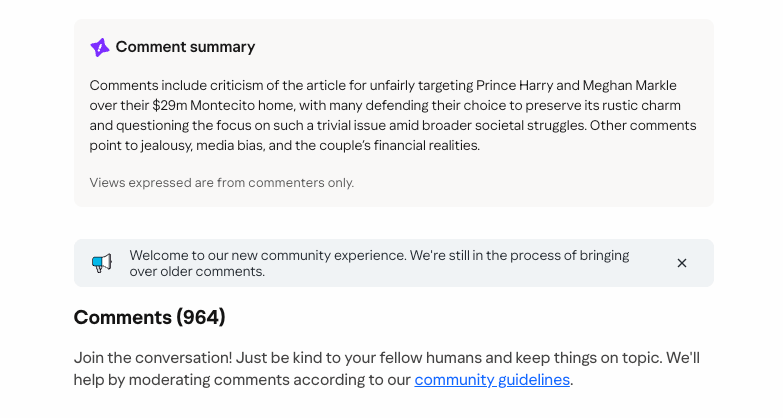
“Comments include criticism of the article for unfairly targeting Prince Harry and Meghan Markle over their $29m Montecito home, with many defending their choice to preserve its rustic charm and questioning the focus on such a trivial issue amid broader societal struggles. Other comments point to jealousy, media bias, and the couple’s financial realities.”
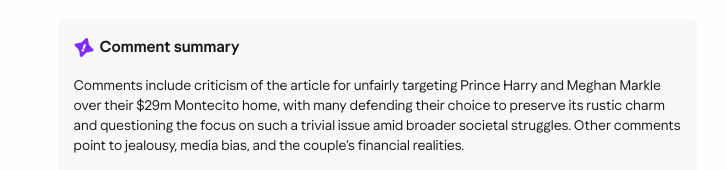
The AI summary leads with “criticism of the article for unfairly targeting.” The first thematic note Yahoo’s own system extracted from its own comment section is that the readers think the article is unfair. The “other comments” framing for the hostile material puts the expected production output in the secondary position. Even the machine summarization of the readership found the pushback to be the dominant signal.
This matters because the AI is not editorializing. It is reading the comments and reporting what the comments say. The system Yahoo built to summarize the reader response is telling the publisher that the reader response disagrees with the article it just published.
The Production Cycle Did Not Get What It Paid For
The hostile comments exist. They are present in the thread. Hooukidden, B.L., Catherine, Spartan, AMA, pumpernikle, and others delivered the expected content. The cycle is not broken. The audience that arrives looking for permission to call the Sussexes grifters received that permission and used it.
But the engagement-weighted distribution skews the other direction. The most-liked comments on the page are pushback. The longest comment in the visible thread is an explicit racial-subtext analysis. The Yahoo AI summary names the readership’s complaint about the article as the primary theme. The cycle ran its standard playbook and the audience response was, in aggregate, “this is silly and we see what you are doing.”
This is the part of the production cycle that gets reported as “engagement” without distinguishing what the engagement consists of. Hello! and Yahoo can both publish the 964 figure as a success metric. The number is real. The number does not distinguish between agreement and rejection. A comment that says “leave them alone” counts the same as a comment that says “grifters.” The pipeline collects the engagement either way.
But the readers who arrive at the next iteration of the cycle will arrive with this thread in their recent memory. They will see Sykes again on the next podcast. They will see Hello! again on the next syndication. The thread that came back at them last time will be part of how they read the next one. The “friend of a neighbor whose kid goes to school with the nanny’s cousin” frame is now in circulation. The “super classist” reading is now in circulation. The “polluted royal genes” naming is now in circulation. None of these have to be supplied by a media critic on a Substack. They are supplied by the readership talking to itself.
What the Kitchen Actually Produced
The Sykes anecdote was supposed to manufacture a controversy. The Hello! piece was supposed to launder the anecdote into a Homes section feature. The Yahoo syndication was supposed to amplify it into the engagement-driven attention economy. The 964 comments were supposed to demonstrate the success of the cycle.
What the 964 comments actually demonstrate is that a sufficient portion of the readership has now seen this production enough times to recognize it. They name the sourcing structure. They name the class coding. They name the racial subtext. They name the no-win framing. They do this in two-sentence comment-section prose, from a wide range of political and personal priors, including from readers who explicitly state they are not Sussex fans.
The kitchen will continue to look like Olive Garden circa 1994. The house will continue to appreciate. The Sussexes will continue to occupy the property they bought. None of that is the news. The news is that the production cycle is starting to face a readership that recognizes what is being done to it and says so out loud in the place the production cycle was designed to extract content from.
The mechanism still works. The mechanism produces less reliably than it used to. The kitchen was supposed to deliver the audience to the conclusion. The audience arrived at a different conclusion, brought the analytical tools with them, and posted them under the article that needed them not to.