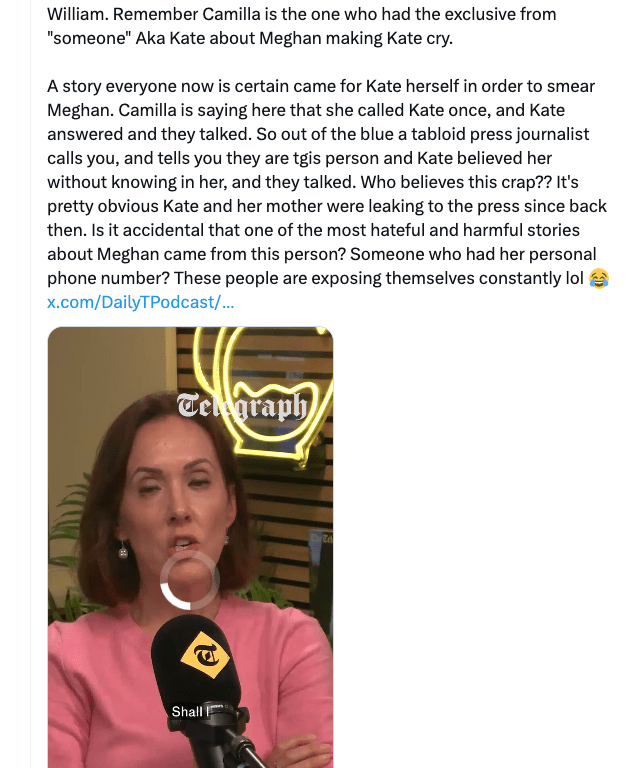
There is a version of the bridesmaid-dress (As Reported by Feminegra) story that has hardened into fact through repetition. The version worth examining is not the one about who actually cried at a fitting in 2018. It is the one about which complaints the palace chose to fight and which it chose to let stand. That choice, documented and on the record, says more than any anonymous source ever could.
What Tominey Actually Reported
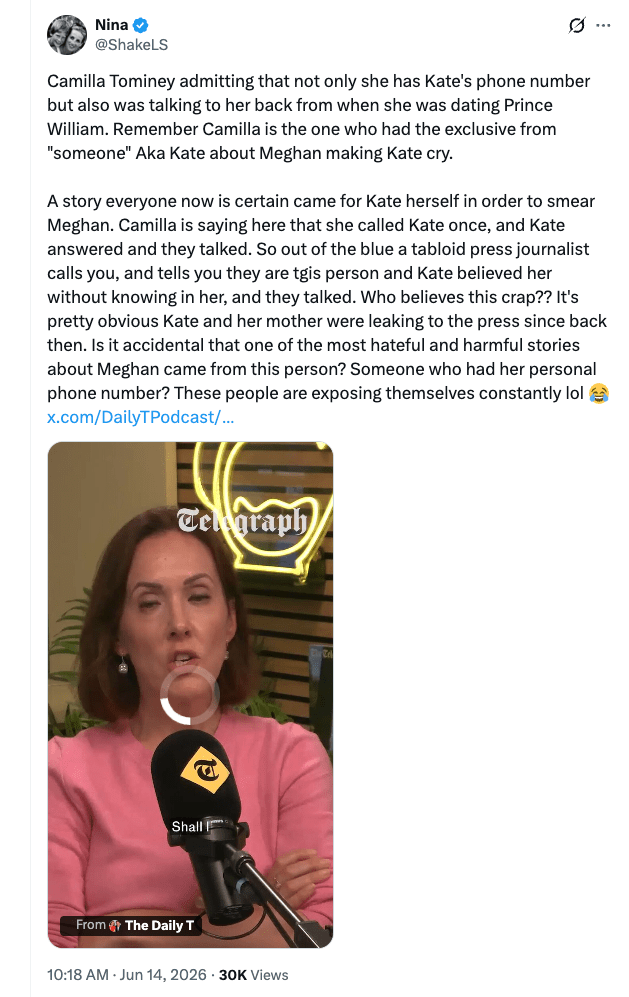
On November 26, 2018, Camilla Tominey, then associate editor at The Telegraph, published the original bridesmaid-dress story. She cited two sources. Her framing was specific: Kate was “left in tears” after a dress fitting, with an insider noting Kate had recently given birth to Prince Louis and was feeling emotional. Tominey has never retreated from that account, describing it as “well-sourced” and saying she later received messages affirming its accuracy.
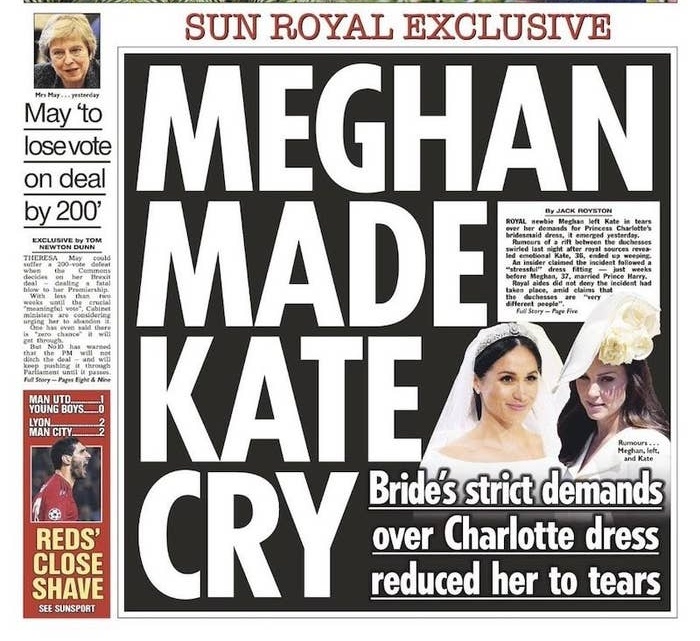
Notice what Tominey did not write. She did not write the headline that the story became. “MEGHAN MADE KATE CRY” was the mass-market escalation, the tabloid compression of a more hedged claim into an accusation. The distance between “Kate was left in tears” and “Meghan made Kate cry” is the distance between a report and a verdict. The press traveled that distance quickly, and the verdict stuck.
When Meghan offered her version to Oprah in 2021, she said the reverse was true, that Kate had made her cry and later apologized with flowers and a note. A later account in Tom Quinn’s Yes Ma’am cited a royal staffer claiming both women ended up in tears and that “all the papers and commentators got this wrong.” The point is not to adjudicate the fitting. The point is that two named principals gave accounts that complicate the original, and only one account was ever treated as authoritative by the machinery that amplifies these stories.
The Vogue Turn
A year after the wedding, Meghan guest-edited British Vogue’s September 2019 “Forces for Change” issue. It sold out in ten days and became the fastest-selling issue in the magazine’s history. The cover featured fifteen women. Five were white.
Tominey’s Telegraph column questioned the “bias” Meghan had shown in choosing fifteen women “of which only five were white,” and offered the line that has followed her since: “If I was pale, male and stale, I’d be feeling pretty discriminated against right now.” The framing treated an issue that foregrounded women of color as a slight against whiteness, an inversion that required reading inclusion as exclusion.
What is worth tracking here is not the column in isolation but the arc. In 2016, Tominey broke the story that Harry was dating Meghan and spoke of her warmly, as confident and self-assured and good for a modernizing monarchy. The traits that earned praise before the marriage became liabilities after it. Confidence read as difficulty. A humanitarian voice read as political. This is not unique to one journalist. Piers Morgan followed an almost identical curve, warm in 2016, vicious by 2021. The constant across both reversals was not Meghan. It was the shift in who the press had reason to protect.
The Tatler Asymmetry
Here is the documented contrast that anchors everything.
In May 2020, Anna Pasternak wrote a Tatler profile titled “Catherine the Great.” It described Kate as “perilously thin,” suggested she felt overworked and trapped after the Sussexes’ departure, and took swipes at Carole and Pippa Middleton. Kensington Palace responded fast and hard. It issued a public statement calling the piece “a swathe of inaccuracies and false misrepresentations which were not put to Kensington Palace prior to publication.” Lawyers contacted the magazine. Tatler initially stood behind Pasternak and her sources, with its editor insisting the palace had known about the cover for months. Within roughly four months, the magazine removed the contested passages from its online edition, including the “perilously thin” line.
So the apparatus exists. It is well resourced, legally equipped, and willing to deploy publicly when the palace decides a story crosses a line. A profile that, by some readings, paid Kate the backhanded compliment of fashionable slimness was a bridge too far. The palace went to the mattresses over it.
Now set that beside the silence. When “MEGHAN MADE KATE CRY” ran globally, when the narrative of Meghan as the duchess who bullied the future queen calcified across years of coverage, the same apparatus issued no statement, sent no lawyers, demanded no correction. The contrast is not subtle, and it does not require a leaked phone call to interpret. An institution that fights “perilously thin” and accepts “made Kate cry” is telling you which stories it considers injuries and which it considers useful.
The pattern predates Meghan, which is what makes it a method rather than a grudge. Diana learned the same lesson in reverse: the briefings ran in both directions during the War of the Waleses, and the side with better access to sympathetic desks shaped which spouse looked wronged that week. What changed by 2018 was not the existence of the machinery but the clarity of its targets. A settled institution had decided who it was protecting, and the press had learned whose version arrived pre-sourced and whose would be treated as special pleading. The bridesmaid story did not introduce a new dynamic. It revealed a mature one.
There is a tell in the verb tenses the coverage uses. Kate’s tears were reported as event, fixed and factual, while Meghan’s account was reported as claim, something she “said” or “alleged” years later. That grammatical split is not neutral. It encodes which narrator the press had already decided to believe before either woman spoke. When the institution wants a story to harden, it lets the active voice do the work: a thing happened, to this person, because of that one. When it wants a story to dissolve, it reaches for the hedge, the “reportedly,” the attribution that quietly reminds the reader the speaker has an interest. Watch the verbs and you can often read the decision before you read the facts.
It is worth saying plainly who absorbs the cost of the silence. The apparatus protects an image, but the image is protected at someone’s expense, and the expense is rarely symmetrical. A correction the palace declines to seek is a correction the damaged party has to chase alone, usually years later, usually in a format (a memoir, an interview) that the same press can then frame as grievance. The machine does not have to lie. It only has to choose its silences carefully, and let the asymmetry of who-must-speak-for-themselves do the rest.
What This Is Not Evidence Of
It is worth being precise about the limits, because precision is what separates analysis from the pile-on.
There is no documented proof that Kate or her family sourced the bridesmaid story. The fact that a reporter possessed access to royal circles establishes access, not authorship of a specific leak. Reporters acquire those channels as a matter of routine, and treating proximity as proof would be exactly the kind of inferential overreach this story has suffered from in the other direction.
Similarly, the claim that Queen Camilla personally thanked Piers Morgan for attacking Meghan should be handled carefully. Morgan said publicly that “several members of the Royal Family” thanked him through intermediaries. The specific attribution to Camilla comes from Omid Scobie’s Endgame, and Morgan himself denied it was Camilla while affirming that others reached out. Palace silence is not confirmation. It is silence, which can mean many things.
None of these softer claims are needed. The asymmetry stands on its own documented record.
Whose Tears Mattered
The bridesmaid story was never really about a fitting. It was a test of whose account the press would treat as fact and whose it would treat as revisionism. Kate’s reported tears, sourced anonymously, became the headline. Meghan’s account, given in her own name, became something to litigate. And the institution that has shown it will pick up the phone to kill a profile it dislikes decided, in this case, that the phone could stay on the hook.
That is the part that is not gossip. The palace has a demonstrated method for correcting the record when it wants to. The method was available. It was not used. The decision not to use it is the story.
 celebchai.com