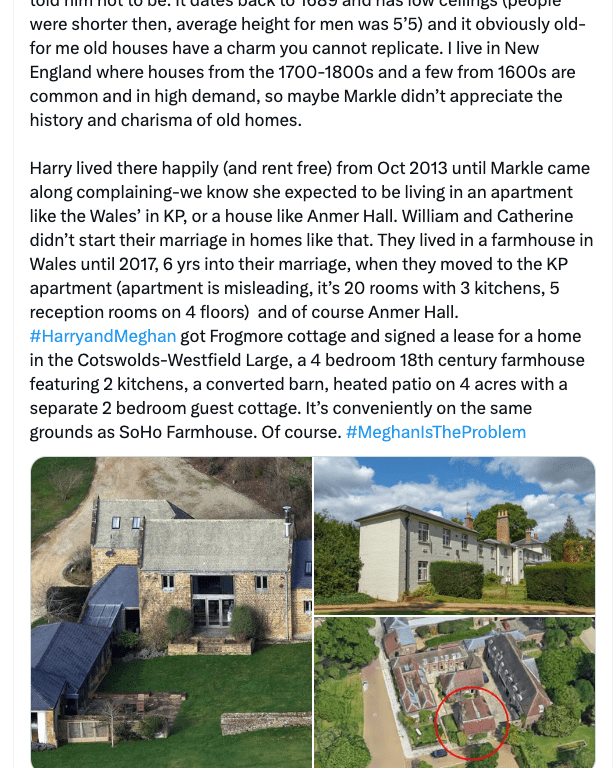
There is a viral thread making the rounds again about the Sussexes and their houses. It runs through the familiar inventory: Nottingham Cottage, Frogmore, the Cotswolds lease, the grounds near Soho Farmhouse. The replies supply the verdict. She is “always wanting more.” She is “sucking others dry.” She is “nouveau riche.” She wanted “Diana’s home.” Give her an inch and she takes a mile.
The thread presents itself as an argument about real estate. It is not. It is an argument about character, and the houses are only the props. What is worth noticing is not whether any single property claim is accurate. It is that the conclusion does not depend on the facts at all. Every possible fact has already been assigned the same meaning in advance.
The accusation that cannot lose
Watch what happens to each piece of evidence.
Harry lived rent-free at Nottingham Cottage for years. In the thread, this is proof of greed: she was ungrateful for free housing.
The couple were given Frogmore Cottage. This is also proof of greed: she always wanted more.
They signed a lease on a house in the Cotswolds. Proof of greed again: did they expect “Pa and Granny” to pay for that too?
They eventually left for California. Proof of greed once more: sucking others dry, then taking the money and running.
Accept a house, and it is entitlement. Critique a house, and it is ingratitude. Take a smaller house, and it is a grudging prelude to demanding a bigger one. Leave entirely, and that is the greediest move of all. There is no behavior available to Meghan, none, that the frame would read as anything other than greed. A version of her that lived contentedly in the 1689 cottage forever would simply be recast as biding her time.
When opposite actions produce the identical verdict, the verdict was not derived from the actions. It was imported and then draped over whatever happened to occur. That is the structural tell of the entire thread, and it is the thing actually worth writing about.
The reversal the frame cannot survive
Here is the test. Take the thread’s own favorite fact, the one it leads with, and read it straight.
A person lives for years in a small, low-ceilinged, centuries-old cottage. By any neutral reading, that is the opposite of grabby. It is modest. It is the behavior the thread claims to admire when it praises its own thatched cottages and 1828 staircases. The same posters who call their own old, cramped homes charming call Meghan’s old, cramped home evidence of a soulless woman who could not appreciate history.
The fact does not generate the greed reading. The greed reading has to be brought in from outside and then projected onto the fact. Strip out the prior belief and the cottage reads as the least entitled thing a person in her position could have done. The frame only works if you already believe the conclusion, which means the frame is not evidence of anything. It is the belief wearing the costume of evidence.
Why greed, specifically
It is worth asking why this particular accusation, rather than “cold” or “rude” or any of the others also floating in the thread. Greed is the efficient choice for three reasons.
It is unfalsifiable, as shown above. No conceivable action disproves it, because contradictory actions are read as the same.
It converts a logistics question into a morality verdict. The underlying matter is mundane: who was assigned which property, who funded which renovation, on what timeline. That is an administrative story about a large institution allocating housing. Greed transforms it into a story about what kind of person she is, which is infinitely more durable and more shareable than a dispute about square footage. Notice that the replies barely discuss the houses themselves. They discuss her soul.
It rides an existing script. “American actress marries up and wants more” is a stock character the audience already carries. Greed slots Meghan into a template that feels true on contact, before any evidence is presented, which is why repliers can lead with their own credentials (“I’m a historic tax credit consultant,” “we live in a 350-year-old cottage”) instead of any fact about Meghan. The credential supplies the sensation of authority. The script supplies the conclusion. Nothing in between has to be demonstrated.
What the record actually shows
For the small number of factual claims the thread does make, the verifiable timeline is worth having on hand, because it does not support the “always demanding more” reading.
The Cambridges did not begin married life in the 20-room Apartment 1A. They moved into it in 2013, two years after their wedding, and only after a renovation funded by the public purse that ran to roughly 4.5 million pounds once asbestos removal was included. Before that they used Nottingham Cottage and split time with a home in Wales. The “they happily brought baby George home to Nott Cott and never complained” line that circulates in the thread compresses and rearranges this; 1A was being prepared for them during that period.
The Sussexes’ Frogmore renovation, the one repeatedly cited as extravagance, cost about 2.4 million pounds of Sovereign Grant money, less than the Cambridges’ 1A refit. Harry repaid that full amount in 2020. The couple moved into Frogmore in April 2019, a few weeks before Archie was born, after the property was converted from five separate staff units into one home.
None of this is offered to argue that the Sussexes were owed anything, or that the institution behaved badly, or that Meghan was a saint. It is offered for a narrower point: the documented facts are mundane and roughly symmetrical between the two couples, which is precisely why the thread does not actually argue from them. It cannot build greed out of the record, so it builds greed out of character assertion and lets the houses stand in as illustrations.
The takeaway
The housing thread is a clean specimen of a particular move. Start with a fixed conclusion about a person. Gather every available fact about her. Assign each fact, regardless of its content, the same meaning. Present the resulting pile as though the facts produced the conclusion, when the conclusion produced the readings.
You can recognize it whenever opposite actions are treated as the same evidence. When staying is greed and leaving is greed, when accepting is entitlement and declining is ingratitude, you are not looking at an argument. You are looking at a verdict that was reached first and decorated afterward. The houses were never the point. They were the wallpaper.
 celebchai.com