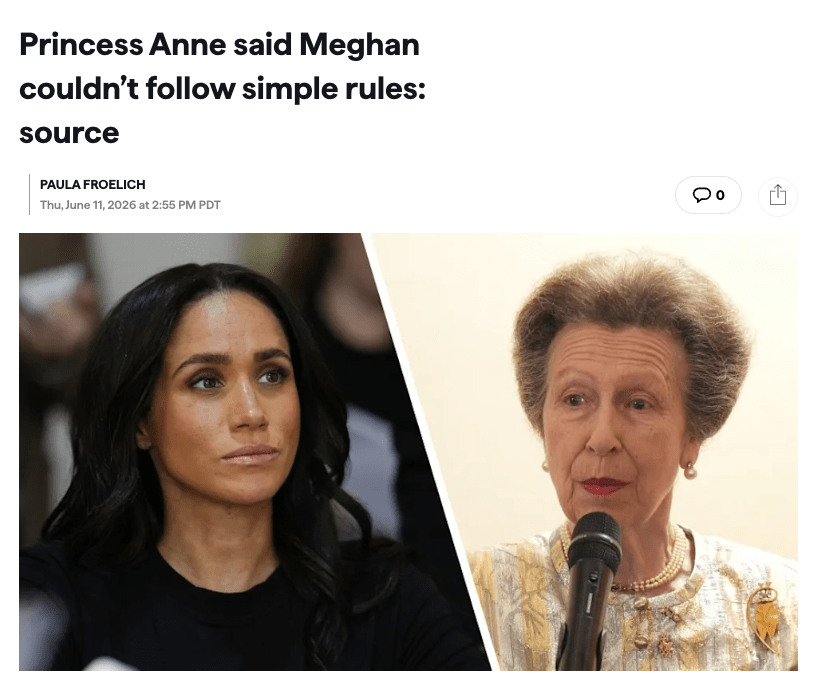
There is a question you can ask of the latest Meghan Markle story that the story cannot answer. It is not a clever question. It is the most basic question there is. Read the headline, read the body, read the version that has since metastasized into a faceless narrator video, and then ask: which rule?
The headline, carried by NewsNation and syndicated outward, is “Princess Anne said Meghan couldn’t follow simple rules: source.” The column underneath it, by gossip writer Paula Froelich, offers this as the load-bearing quote, attributed to an anonymous source relaying the words of other anonymous people: Meghan “was incapable of fitting in with anyone because she couldn’t cope with following simple rules as she felt her way was better.”
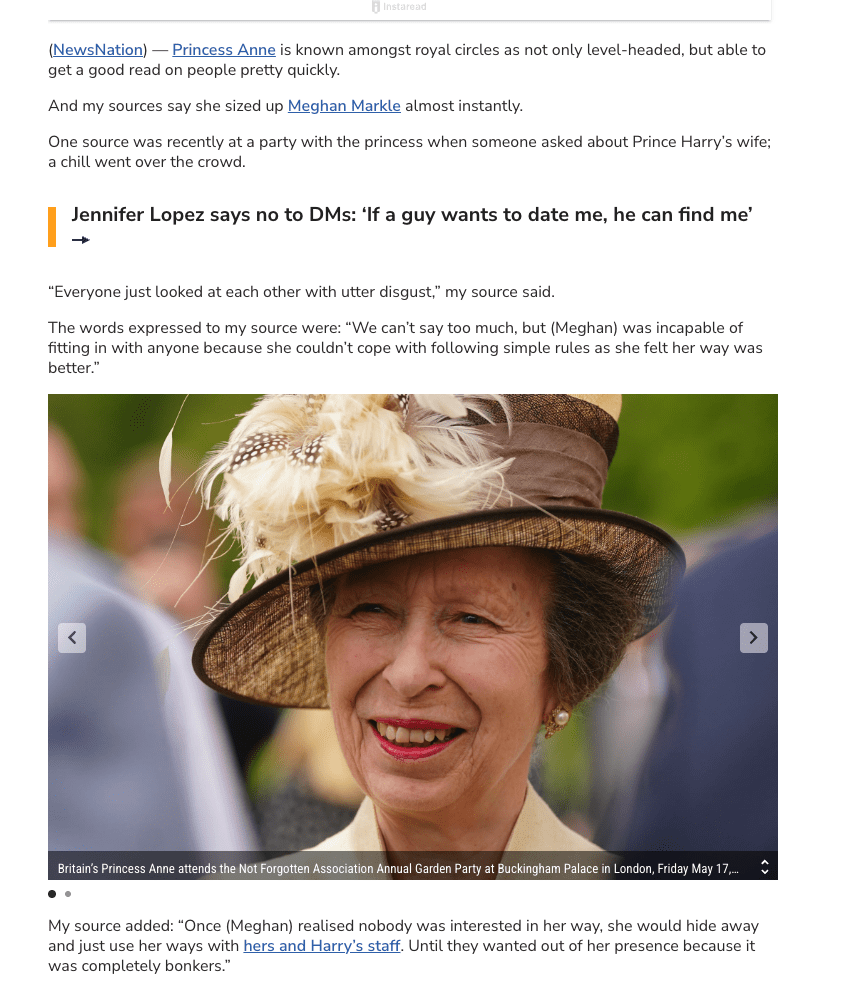
Simple rules. Which ones?
The piece never says. Not one. No protocol is named. No occasion is given. No date, no room, no event, no witnessable moment where Meghan was handed a rule and declined to follow it. The video version that came afterward inherits the same emptiness and dresses it up in documentary language: Meghan “found it difficult to accept certain established protocols and customs.” Certain protocols. Certain customs. The vocabulary gestures at specificity while delivering none.
This is not sloppy writing. The vagueness is the entire mechanism, and it is worth slowing down to see exactly how it works.
A named rule can be checked
Suppose the story had said: at a particular dinner, Meghan was told guests stand when a certain royal enters, and she stayed seated. That is a claim with edges. You could find out whether the dinner happened. You could ask whether that protocol actually applied. Someone present could confirm or deny it. The claim would be exposed to reality, and reality might push back.
“Simple rules” has no edges. It cannot be confirmed because there is nothing to confirm. It cannot be denied because there is nothing specific to deny. It floats free of any event, which means it can never be wrong. A claim that can never be wrong is not reporting. It is an invitation. The reader is handed an empty container labeled “rule Meghan broke” and asked to fill it from their own supply of whatever they already believe about her.
If you already think she is difficult, you will picture her being difficult. If you think the institution is rigid, you will picture something petty. The story does not have to do the work of persuading you, because you do the work yourself, and you do it in a way perfectly calibrated to what you were already inclined to think. That is why these stories travel. They are not arguments. They are mirrors.
The word “simple” is doing a second job
Notice the adjective. Not “rules,” but “simple rules.” That word is not decorative. It pre-loads the verdict.
If the rules are simple, then failing them cannot be a reasonable disagreement, a clash of values, an institution being inflexible, or a newcomer being set up to fail. It can only be a defect in the person. Simple things are easy. Easy things are failed only by the difficult, the arrogant, the “bonkers,” to borrow the source’s word from later in the same piece. By the time you reach the end of the sentence, the conclusion has been smuggled in through a single adjective, and you never got to examine it because it arrived disguised as a neutral description.
Strip “simple” out and the claim collapses into something testable and boring: Meghan and the institution disagreed about some rules. That happens to every person who marries into anything. It is not a story. So the word stays in, and the story survives.
What gets lost when there is nothing to lose
Compare this to the royal coverage that does name specifics, the genuinely concrete reporting about who stood where, which event, which exchange. You can argue with those. People do. The arguing is healthy because the claims are real enough to bruise. A claim with no specifics never bruises. It cannot be litigated, corrected, or contextualized. It can only be repeated, and each repetition makes it feel more true while adding exactly zero to the evidence.
By the time this reached its video form, the single anonymous source describing one party had become “reports circulating among royal commentators.” The pluralization was free. No one found a second source. They simply changed “source” to “reports” and the claim grew a chorus it never had.
The question the construction is built to prevent
So here is where we land. “Which rule?” sounds like a small question, the kind you would expect any real account to answer in passing. The fact that this one cannot, in any of its forms, across every outlet that carried it, is not a minor gap to be filled in later. It is the design.
The story is built specifically so that you cannot ask it. Name a rule and the whole thing becomes checkable, and once it is checkable it might be false, and a claim that might be false is a liability. So no rule is named, ever, by anyone, and the construction holds.
The next time one of these arrives, you do not need to know anything about the royal family to test it. You only need one question, and it is the one the story spent all its effort making sure you would not think to ask.
Which rule?
 celebchai.com