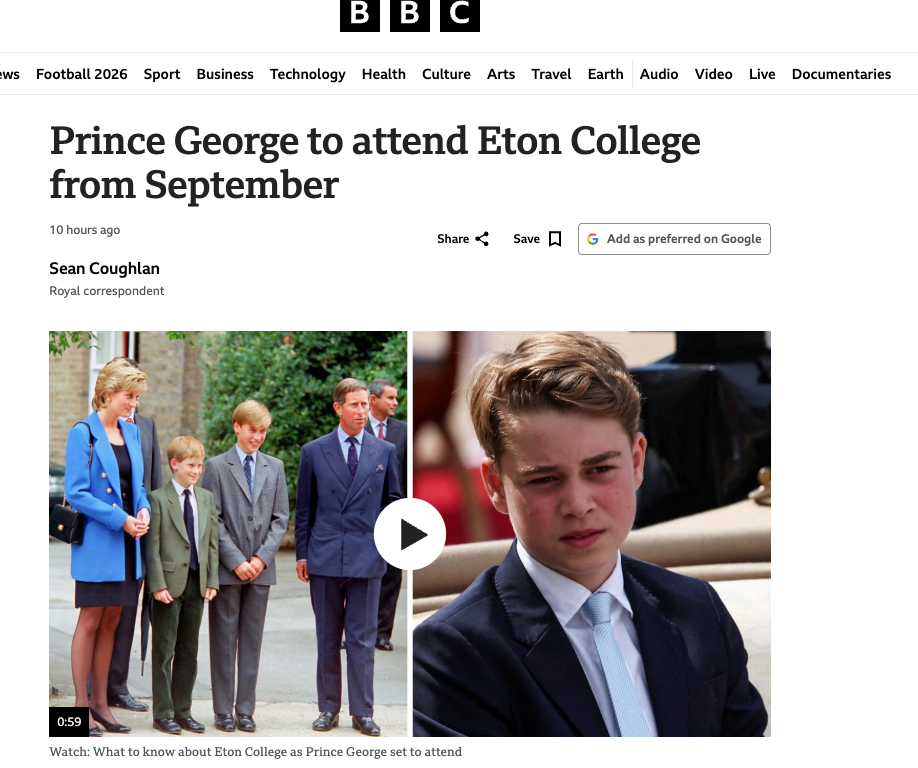
Kensington Palace confirmed it on June 16: Prince George will start at Eton College this September.
He turns 13 in July, he is finishing up at Lambrook, and now he is off to the school his father attended and, by most accounts, genuinely enjoyed. After months of speculation about whether he would follow his mother to Marlborough or land somewhere co-educational, the answer turned out to be the one the bookmakers and the briefers had assumed for years. Honestly, good. This is a happy story, and it deserves to be read as one.
Here is the part that makes it more than a school announcement. Eton sits in Windsor, just west of London, a short distance across the river from the family’s home at Forest Lodge. William and Kate moved there to make it their long-term base, and now their eldest can board during term while staying close to his parents and siblings. Pupils typically go home every couple of weeks, and every boy gets his own room from day one in a small house of around 55, looked after by a house master and a dame. For a 13-year-old leaving home for the first time, close to home and well looked after is about as good as it gets.
Why this matters more for this family than most
To understand why this is worth celebrating, you have to go back a generation, to the school George is not going to.
When Charles was a boy, the natural path for a future king ran through Eton. It was the traditional choice, it was close to Windsor, and it was where the family had long sent its sons. But his father, Prince Philip, overrode that. Philip had thrived at Gordonstoun, the spartan boarding school on the Scottish coast near Inverness, and he was determined his sensitive, somewhat timid son would be toughened up the same way. So instead of Eton, Charles was flown north to Moray.
It did not go well. Gordonstoun in that era meant pre-dawn runs, ice-cold showers, dormitory windows left open through the Scottish winter, and rock-hard bunks. Charles was bullied, including by his own rugby teammates, and mocked for his ears. Anyone who befriended him was accused of currying favor with the prince, which left him isolated. In letters home he described it as “absolute hell here most of the time” and begged to come home. The phrase that has followed the school ever since, “Colditz in kilts,” became shorthand for how he felt about the place, a reference to the Nazi prisoner-of-war camp. One contemporary later said Charles “utterly detested” it, and a biographer wrote that he was still complaining about how unhappy he had been there well into his sixties. The version dramatized in The Crown put it bluntly: a “prison sentence.”
Charles, to his credit, softened the story in public over the years. In a 1975 speech to the House of Lords he pushed back on what he called the “rot” talked about Gordonstoun, said it had demanded more of him mentally and physically than most schools would have, and credited it with teaching him about his own abilities. He has played down the misery many times since, and this year he even became patron of the Gordonstoun Association, the role his father once held. People are allowed to make peace with their pasts. But the letters were written at the time, and they say what they say. The boy was wretched, and the man who sent him there had decided that was the point.
So when a future king actually gets to go where he’s happy, notice it
That is the real weight behind this week’s announcement. William went to Eton from 1995 to 2000 and, unlike his father a generation earlier, reportedly found it a place that suited him. Interviewed at 18 as he was finishing up, he said he had enjoyed being able to go about Eton as just another student, which is about the most a boy in his position can hope for. Harry followed him there. For William, choosing Eton for George is not about prestige or tradition for its own sake. It is a father picking the school he himself knew and trusted, near the home he picked precisely so the family could stay together. The contrast with his own father’s childhood could hardly be sharper. Charles was sent away from the path his family had always taken, to a school chosen to harden him, and he was miserable. George is being kept close, on the path his father walked happily, by parents who have said for years they want to raise their children as a normal a family as the circumstances allow.
And yes, of course they can afford it. Eton runs to roughly £63,000 a year, now with the government’s VAT on private school fees added on top, which is a serious sum to most people and a rounding error to this family. That is worth saying plainly rather than tiptoeing around: when you have the means, you spend them on what makes your child happy and secure. Every parent who can does exactly that. The Wales family can, and they have, and there is nothing to apologize for in it. The measure of a good parent here is not the price tag but the priority, and the priority is clearly the boy.
Predictably, the choice drew a little political grumbling. A handful of MPs asked why the future king isn’t going to the local comprehensive, the usual point about whether state schools are “good enough” for everyone else. It is a fair debate to have in general, but it rather misses the specifics of this child. As one councillor pointed out, George will be one of the most famous 13-year-olds on the planet, and the security apparatus that travels with him is simply not something a state school can be expected to absorb. Or, as the writer Mary Kenny put it more cheerfully, everyone would go to Eton if they could. The family had, in the words of one school guide, an unrivalled choice of schools available to them, and they chose the one they know.
So: congratulations to George. May Eton be for him what it was for his father and not what Gordonstoun was for his grandfather. May the early mornings be reasonable, the room be his own, and home be close enough to feel close. A future king is being allowed to go somewhere he is likely to be happy, chosen by a father who knows the place and a mother who weighed the alternatives. After the story of the generation before, that is genuinely something to smile about.
 celebchai.com