The latest filings in the Blake Lively v. Wayfarer litigation have shifted the focus away from liability and onto a new battle: attorneys’ fees.
After obtaining dismissal of the Wayfarer complaint under California Civil Code § 47.1, Lively seeks approximately $7,495,526.87 in attorneys’ fees and $539,514.01 in litigation costs, arguing that she successfully defended a retaliatory defamation action and is therefore entitled to recover her reasonable litigation expenses. The dispute is no longer whether Lively is entitled to fees. Judge Lewis Liman has already ruled that she qualifies as a prevailing defendant under § 47.1. The remaining question is how much is reasonable. Yesterday, Wayfarer filed its response. Blake filed hers https://celebchai.com/2026/07/05/seventy-percent/ on June 30th, 2026 while Wayfarer had till July 13, 2026 to oppose it.
Lively’s Position
Lively argues that the litigation quickly became inseparable. Although there were two related actions, one defensive and one affirmative, her attorneys contend that the factual investigation, motion practice, discovery, witness preparation, and litigation strategy overlapped so extensively that much of the work cannot realistically be divided between the two cases.
Importantly, Lively did not simply submit every legal bill she incurred. Her fee expert, Diana Kantner, states that she first removed all work that related exclusively to Lively’s affirmative lawsuit. She then divided the remaining work into two categories:
- Wayfarer-only defensive work: $2,267,288.75
- Intertwined work: $5,228,238.12
Together, those amounts total the requested $7,495,526.87. Kantner explains that only work reasonably connected to defending the Wayfarer complaint was included, while offensive work performed solely in Lively’s own action was excluded before the fee application was prepared.
Wayfarer’s Opposition
Wayfarer does not dispute that Lively prevailed under § 47.1. Instead, it argues that the request is vastly overinclusive. Its opposition identifies several categories that it contends should not be shifted, including:
- Rule 11 proceedings https://www.courtlistener.com/docket/69510553/1270/lively-v-wayfarer-studios-llc/
- Spoliation motions
- Internal attorney conferences
- Media and public-relations work
- Administrative and clerical tasks
- Work benefiting co-defendants
- Work relating to Lively’s affirmative claims
- Travel
- Discovery unrelated to defending the defamation claim
Wayfarer also criticizes the staffing of the case, noting that the request includes work performed by 82 separate timekeepers across two national law firms.
The Rule 11 Issue
One of the more interesting disputes concerns Rule 11 sanctions. Wayfarer argued that approximately $529,000 in Rule 11-related work should be excluded because Rule 11 proceedings were collateral to the defense of the defamation action. However, the Rule 11 order provides important context. Judge Liman granted Lively’s Rule 11 motion in part, finding that several claims asserted by certain Wayfarer plaintiffs were legally frivolous and factually baseless. Specifically, the court found no basis for certain plaintiffs to assert civil extortion, interference, and implied covenant claims against Lively or Reynolds.
The court nevertheless declined to award Rule 11 attorneys’ fees because those sanctionable claims did not materially increase the litigation burden beyond the non-sanctionable claims. Instead, the court imposed a formal reprimand on Wayfarer’s counsel. That distinction is significant. The Rule 11 motion was successful in establishing violations, even though the sanction imposed was nonmonetary. Accordingly, the Rule 11 work cannot simply be dismissed as unsuccessful or unnecessary. Whether those hours are recoverable under § 47.1 is a different statutory question than whether Rule 11 itself warranted a fee award.
The Strongest Arguments for Reduction
Not every objection raised by Wayfarer appears equally persuasive. Its strongest arguments concern:
- excessive internal conferences among numerous attorneys,
- clerical and administrative work billed at attorney rates,
- public-relations strategy,
- work performed for other parties,
- and whether all “intertwined” work truly qualifies as intertwined.
The opposition estimates, for example:
- approximately 728.9 hours and $894,506.20 for internal attorney conferences,
- approximately 185.3 hours and $103,508.85 in clerical work,
- approximately 277.4 hours and $309,075 involving other claims or parties,
- and approximately 47.5 hours and $55,145.30 in travel-related billing.
Some of these categories are likely candidates for judicial scrutiny.
Where Wayfarer’s Analysis Is Less Convincing
Several of Wayfarer’s headline numbers are based on keyword searches. For example, if a billing entry merely referenced “Rule 11,” “strategy,” or another keyword, Wayfarer’s analysis frequently counted the entire block-billed entry toward its reduction calculations because it could not separate individual tasks. Wayfarer expressly acknowledges this methodology. That means its dollar figures are illustrative rather than precise. Likewise, many challenged entries involve work that could reasonably serve multiple purposes simultaneously, making complete exclusion difficult.
The New York Times Comparison
Wayfarer repeatedly compares Lively’s $7.5 million request with The New York Times’ separate anti-SLAPP fee application seeking approximately $181,623. The comparison is eye-catching but incomplete. The Times defended only the claims asserted against it. Lively defended herself throughout a sprawling, consolidated federal action involving numerous defendants, multiple causes of action, extensive motion practice, and related proceedings. The scope of representation was substantially different.
What Is the Most Likely Outcome?
The filings suggest that neither side is likely to receive everything it seeks. Lively has already crossed the most significant hurdle by establishing her entitlement to fees under § 47.1. At the same time, fee petitions of this size almost always receive careful judicial scrutiny. A court reviewing these submissions is likely to:
- preserve the core defense work,
- allow a substantial portion of the intertwined work,
- reduce duplicative conferencing,
- trim clerical billing,
- reduce or eliminate some public-relations work,
- scrutinize billing related to other parties and claims,
- and examine whether certain expenses were adequately documented.
In other words, the central dispute is no longer whether Lively deserves attorneys’ fees. It is how much of nearly $8 million in requested litigation expenses can fairly be attributed to successfully defending what the court has already determined was, at least in significant part, a retaliatory lawsuit.
Based on the filings to date, a substantial award remains the most likely outcome. The real question is where the court draws the line between legitimately intertwined defense work and work that primarily advanced other claims or reflected litigation inefficiencies.
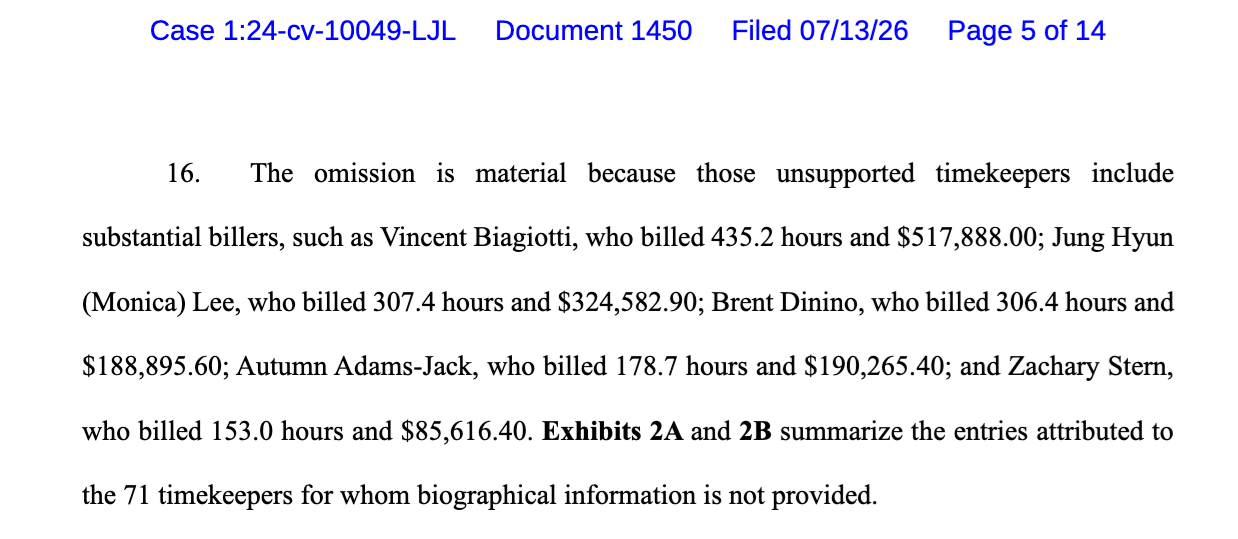
The five timekeepers identified in paragraph 16 total:
- Vincent Biagiotti: $517,888.00
- Jung Hyun (Monica) Lee: $324,582.90
- Brent Dinino: $188,895.60
- Autumn Adams-Jack: $190,265.40
- Zachary Stern: $85,616.40
Total: $1,307,248.30
Against Lively’s $7,495,526.87 fee request, removing every dollar billed by those five would leave:
$7,495,526.87 − $1,307,248.30 = $6,188,278.57
That would be a reduction of approximately 17.4%, leaving Lively with about 82.6% of her requested fees. There is a broader figure, however. Wayfarer says there are 71 allegedly unsupported timekeepers, not merely the five substantial billers named in paragraph 16. Exhibit 2B totals all 71 at: https://www.courtlistener.com/docket/69510553/1450/2/lively-v-wayfarer-studios-llc/
$2,470,100.60
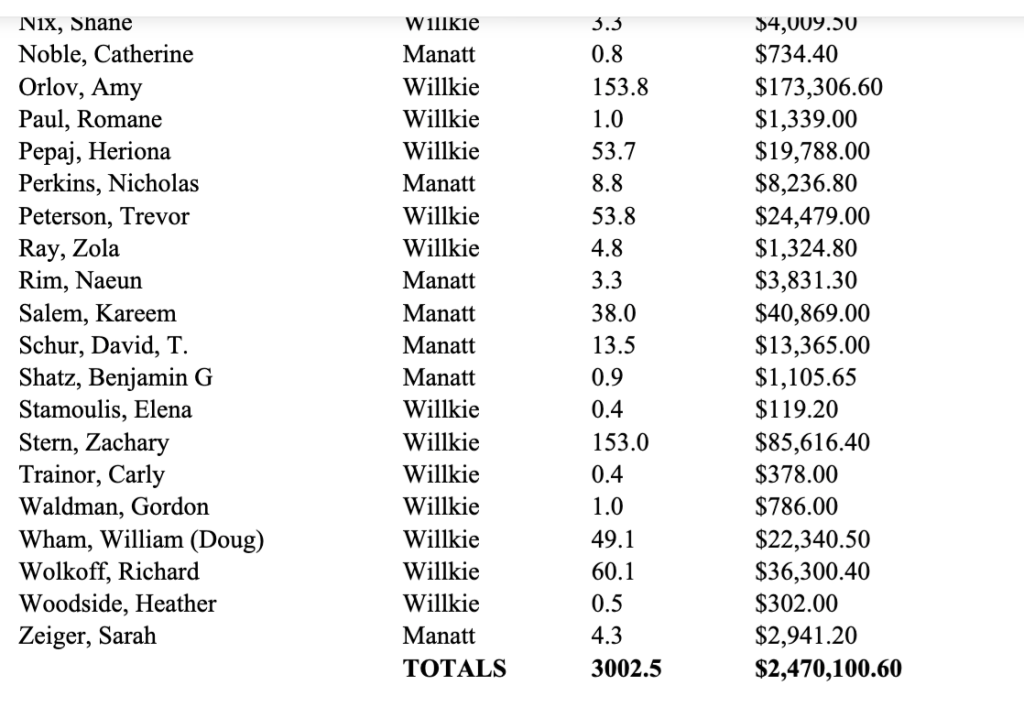
Thus, even in the extreme and unlikely scenario that Judge Liman removed every dollar billed by all 71 allegedly unsupported timekeepers, the calculation would be:
$7,495,526.87 − $2,470,100.60 = $5,025,426.27
That would still leave Lively with approximately 67% of the entire attorney-fee request, before considering the separate $539,514.01 in requested expenses. So the practical range based solely on this “unsupported timekeepers” objection is:
| Hypothetical reduction | Fees remaining |
|---|---|
| Remove only the five named billers | $6,188,278.57 |
| Remove all 71 challenged timekeepers | $5,025,426.27 |
We had predicted 70% which is an awesome win. I hope Blake buys some Lorraine to feel better.

