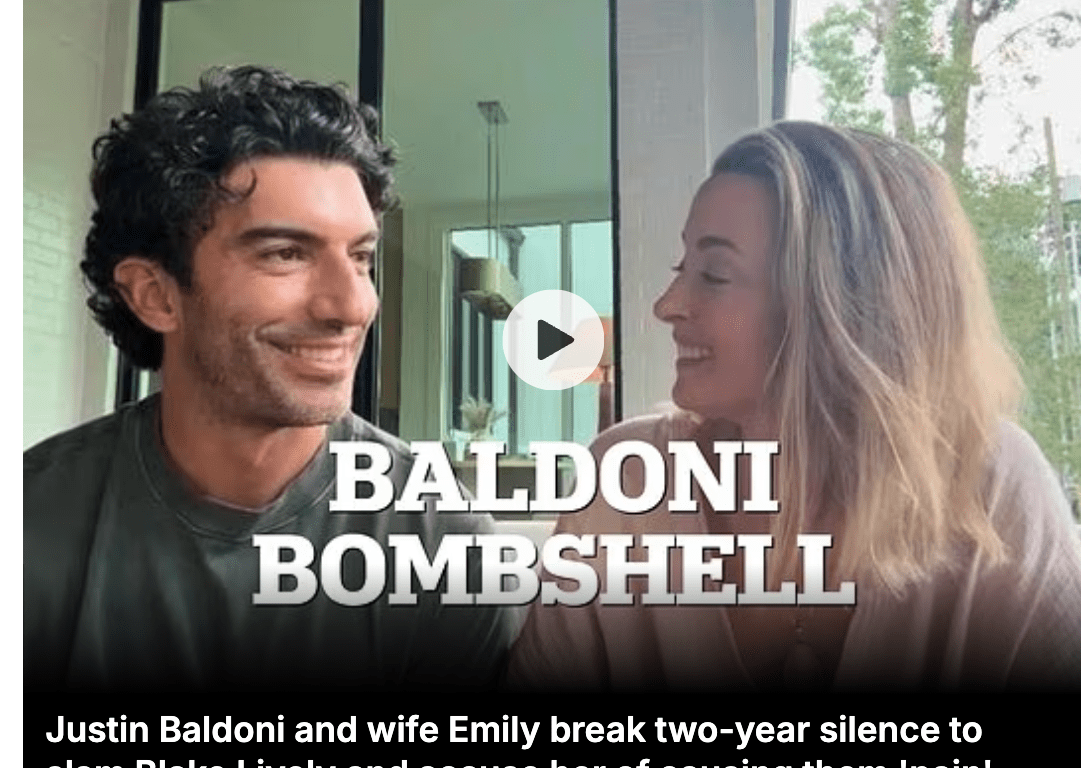
Justin Baldoni and Emily Baldoni ended two years of public silence on Wednesday with an Instagram video built around one sentence: “The truth, and the facts, have spoken for themselves.” The Daily Mail ran it as a lead story. The comment section converted it into a verdict within the hour. It is worth checking that sentence against the record, because the record says something quite different from what the video invites viewers to hear.
What the facts actually said
Start with the ruling that ended Baldoni’s offensive case. In June 2025, Judge Lewis Liman dismissed the Wayfarer Parties’ $400 million defamation suit against Lively, Ryan Reynolds, and the New York Times. The dismissal rested principally on the fair report privilege and the litigation privilege. Those are determinations that Lively’s communications were legally protected. They are not findings that her allegations were true, and they are equally not findings that they were false. The suit did not fail because a court weighed the evidence and cleared Baldoni. It failed because his own lawyers built a defamation claim that could not survive the privileges attached to the very filings he was suing over.
Then came June 12, 2026, and Dkt. 1440. Liman granted Lively’s motion for attorneys’ fees and costs under California Civil Code Section 47.1, the statute creating a remedy for retaliatory suits brought against people who report sexual harassment. He denied the treble and punitive damages components, but on Rule 54 procedural grounds: a post-judgment motion is the wrong vehicle for damages, which fall within neither costs under 28 U.S.C. section 1920 nor any ordinary meaning of attorneys’ fees. The denial was about the procedural vessel, not the conduct.
The grant, by contrast, required substantive findings. To reach fees under 47.1, Liman had to conclude that Lively established the statutory predicate and that the Wayfarer Parties failed to carry their burden of defeating the privilege. He walked through the three exhibits they offered. Two went to extraterritoriality, an argument that failed because the Wayfarer Parties had themselves invoked California law as the basis for their defamation claim. The third, a deposition fragment containing the word “extortion,” he found too vague and unsupported to carry their burden. He rejected their Noerr-Pennington argument in a sentence: fee shifting is not civil liability within the meaning of that doctrine.
Read plainly, the June 12 ruling means a federal judge determined that Baldoni’s $400 million suit falls within a statute the California legislature wrote specifically to make retaliatory litigation against harassment claimants expensive. That is the fact that has spoken. The application filed June 30, seeking $8,035,040.88 in fees and costs supported by 174 pages of line-item billing records, is the direct consequence of that determination. The only question still open is the amount.
The video’s method
Against that record, examine what the video does. It never mentions the June 2025 dismissal of Baldoni’s own case. It never mentions Section 47.1 or what the statute exists to do. It never mentions that the only party currently facing a court-ordered financial consequence in this litigation is Baldoni. Instead it offers “injustice,” “untruthful,” and “disguise as a fight for women,” each floated without a referent, each safely non-specific.
The non-specificity is the design. A concrete claim about Lively could create exactly the exposure the settlement structure was built to close out. An abstract claim about injustice cannot be falsified, cannot be sued over, and cannot be checked against a docket. “The truth and the facts have spoken for themselves” is the purest version of the move: it asserts vindication while pointing at nothing, trusting the audience to supply the verdict the record does not contain.
What the audience supplied
The Daily Mail’s comment section shows the mechanism working in real time, and it is worth reading closely because those comments are not a sideshow. They are the product the video was built to generate.
The dominant strain converts the empty assertion into a court victory. One commenter writes that “he won in court and more importantly he won in the court of public opinion.” Another declares that “truth won and exposed Blake Lively and Ryan Reynolds.” A third says the case ended because “his evidence was stronger and he prevailed.” None of this happened. There was no trial, no verdict, no finding on the evidence. His case was dismissed; her fee entitlement was granted. The commenters are not summarizing the record. They are completing the sentence the video left open.
A second strain reveals that some readers noticed the emptiness. “What exactly did they address in this video? They didn’t really say anything worth while,” one asks. Another: “I’m confused they said nothing in this article.” A reply supplies the explanation without recognizing what it concedes: “They said it without saying it.” That is precisely correct, and it is the entire strategy in seven words.
A third strain does the work the video could not legally do itself. Commenters call Lively “an entitled psychopath,” speculate that she “came on to him and he rejected her,” and pronounce her career over. The video’s speakers said none of this. They did not have to. The abstraction at the top licenses the specificity at the bottom, and the specificity at the bottom carries no legal risk for the people at the top. That division of labor is not an accident of the format. It is the format.
And the few commenters who push back on factual grounds get corrected with confidence rather than citations. When one asks where the claim came from that Baldoni was ordered to pay fees, the question sits unanswered while “Justice for Justin” accumulates upvotes around it.
Why there is no answer to point to
The May settlement dismissed Lively’s remaining claims with prejudice, without payment, while preserving the 47.1 motion and attaching mutual appeal waivers. That structure guaranteed there would never be a jury verdict on the harassment allegations, which means there would never be an authoritative public answer. Both sides understood this when they signed. The absence of a verdict is the terrain the video is fighting on.
And this is the second act of a coordinated campaign to fill that empty space. When the settlement disclosed in May, Bryan Freedman appeared on Megyn Kelly’s show framing procedural silence as a merits verdict and instructing the audience to move on. Now the client himself appears, framing the same silence as vindication and promising there is more to say. The segment tested the narrative. The video personalizes it. Both operate on the same principle: where the record is silent, speak first and speak loudest.
There is one more layer, and it comes from the fee motion itself. Buried in the expense schedules is roughly $173,000 paid to GBX Holdings, whose analysts spent months preserving and sentiment-coding the online commentary about this case, including coverage of the Freedman appearance. The reaction machine is already an evidentiary exhibit. Every comment declaring Lively a narcissist beneath Wednesday’s article is producing more of the material that has been quantified, at $250 an hour, as part of the record of what was done to her reputation. The video feeds the machine that the fee motion asks Baldoni to pay for measuring.
The timing
The video did not arrive on a random Wednesday. Lively’s full application landed June 30. The Wayfarer response is due July 13. The video landed July 8, five days before Baldoni’s lawyers must file the brief attacking the fee expert’s cutoff date and the intertwined-work theory. A sympathetic public narrative about an injustice inflicted on a healing family is not evidence, and Liman will not read Instagram. But the fee ruling, whenever it issues, will be covered by the same outlets now running the video, and the frame in which that coverage lands is being constructed right now. When Liman rules, whatever fraction of the shared-work fees he allows through, the coverage will be filtered through whichever narrative won the intervening weeks. That is what these five days are for.
The correction that needs making
The claim that inverts the record deserves a direct answer: that Lively lost and Baldoni prevailed. The scoreboard, from the docket rather than the comments: Baldoni’s $400 million case, dismissed with prejudice, unappealable by his own agreement. Lively’s affirmative claims, mostly dismissed and then settled without payment, also by agreement. Lively’s Section 47.1 fee entitlement, granted, with only the amount contested. Treble and punitive damages, denied on procedural grounds, with Liman’s footnote 8 marking the counterclaim as the vehicle that would have carried them.
Neither party got what they filed for. But only one party is currently subject to a fee-shifting determination under a retaliation statute, and it is the party now on Instagram announcing that the facts have spoken for themselves. They have. Just not in his favor.
 celebchai.com