“Clausula” is a Latin rhetorical term for the closing phrase or concluding section of a sentence or passage, particularly one that has a specific rhythmic or structural impact.
In classical rhetoric, the clausula was considered important because it’s what the audience remembers. It’s the final cadence. So a “dignity clausula” is the closing frame that does the final argumentative work and leaves a lasting impression.
In Larman’s piece, it’s specifically that final paragraph where he pivots from discussing the Sussexes’ “star quality” to “the absence of dignity…making bank out of a VIP wellness retreat” versus Charles visiting “with serious purpose.” That’s the clausula because it’s where all the prior scaffolding (the concessions, the comparisons, the financial focus) crystallizes into a single judgment that closes the argument.
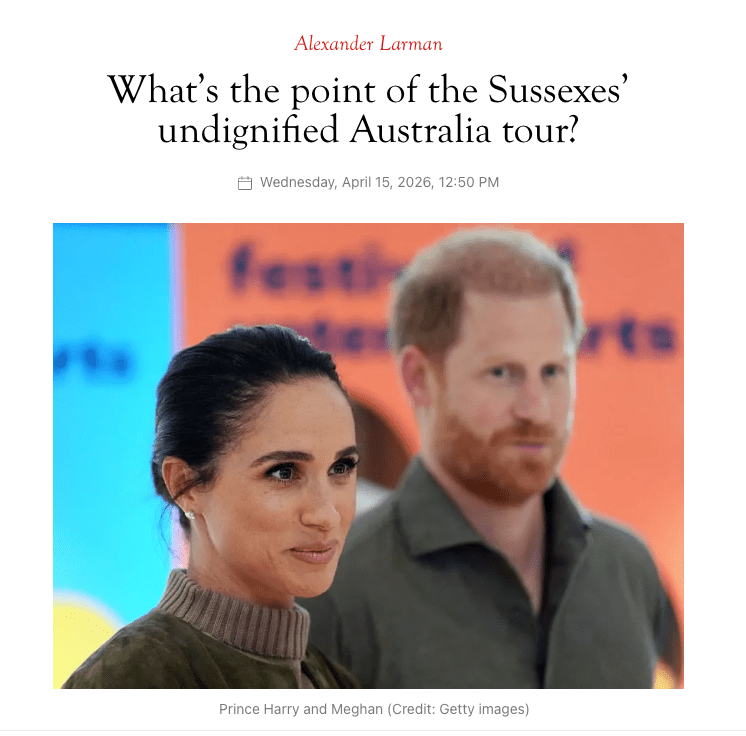
Alexander Larman’s Spectator piece on the Sussex Australia tour demonstrates how institutional media performs status hierarchy not through explicit argument but through rhetorical structure. The piece exemplifies the delegitimization mechanics that have become standard in anti-Sussex coverage: concession-as-trap, financial motive attribution, comparative inversion, and the strategic deployment of “dignity” as an unchallengeable legitimacy marker.
The Opening Move: Status Through Hyperbole
This is mock-heroic framing at its most efficient. The comparison to the first European colonial arrival at Australia simultaneously elevates (this visit is historically significant) and demolishes (through absurdity). No reader believes this is actually true; the hyperbole functions as permission to dismiss. Before a single argument is made, Harry and Meghan occupy a diminished status space.
The subsequent language locks this in: “quasi-royal tour,” “quasi-state visits from private citizens.” The repeated “quasi” prefix becomes a refrain of delegitimization. They are not doing something; they are performing something. They are not royals; they are pretending at royalty.
Concession-as-Rhetorical Scaffolding
Larman grants early ground: “most observers acknowledge that Prince Harry is generally at his best when he is allowed to go off the leash and meet ordinary people” and “the couple’s visit is receiving…mixed notices” with “early PR successes.”
These concessions are structurally essential to the piece’s persuasiveness. They inoculate against accusations of unfairness. But notice the frame around them: Harry is “at his best” when “allowed to go off the leash”—language typically applied to dogs or uncontrolled children. The “mixed notices” formulation allows Larman to acknowledge positive coverage while implying that such positivity is naive or uninformed.
The toy meerkat anecdote and “Call me Meg” moment function as exhibits in a case for trivialness, not as genuine evidence of connection. These are reduced to “catchphrases” and “quips”—lightweight utterances from lightweight figures.
Then the pivot: “Set against the early PR successes of the Sussexes’ tour is a sense among many that it should never have taken place at all.”
The concession has been absorbed and neutralized. Early wins become mere surface activity obscuring deeper problems. The word “sense” is doing critical work here—it implies intuitive, near-universal understanding rather than debatable opinion. “Among many” creates the appearance of consensus without naming who these observers are.
Financial Motive Attribution and Structural Reduction
The Sydney Morning Herald quote (“Australia was good to Harry and Meghan. Now they want to use us as an ATM”) appears as objective reality rather than editorial position. This is a standard delegitimization technique: outsource the aggressive framing to another publication, then treat it as established fact.
The £1,675 VIP ticket price is repeated and emphasized. The “Her Best Life Retreat,” complete with on-stage interview and photo opportunities, is presented as inherently crass. The piece doesn’t argue that commercial activity is incompatible with serious public work; it simply structures the narrative so that the two become mutually exclusive categories.
Notice what disappears: any discussion of what the retreat actually offers, who attends, what outcomes result. The financial cost becomes synecdoche for the entire enterprise. Harry and Meghan are reduced to their commercial motivation, and commercial motivation is presented as transparently mercenary.
The language of “commercially driven antics” performs a kind of linguistic collapse. “Antics” suggests foolishness and performance rather than deliberate action. This is not a business model; it is antic behavior.
Comparative Delegitimization: The King Charles Reset
The extended contrast with King Charles’s US visit is where the piece deploys its most sophisticated delegitimization architecture. This is not direct criticism of the Sussexes; it is establishment of hierarchy through comparison.
Charles and Camilla’s visit includes “affairs of state,” “a royal address to Congress and a military review,” “private meetings with President Trump,” and a diplomatic “reset” of the special relationship. These activities operate at the level of geopolitical consequence.
The Sussexes’ tour, by contrast, is “informal and far more commercially minded.” It has “no serious purpose.”
But Larman goes further. He references King Charles’s decision not to meet Epstein survivors, quoting a palace statement about not disrupting ongoing investigations. This is presented without the critical framing it received elsewhere; it appears here as thoughtful caution. The contrast is: Charles makes difficult decisions in the service of justice; the Sussexes make commercial decisions in the service of “Brand Sussex.”
The Winnie the Pooh reference (“golden-haired wonder with little brain”) technically ridicules the King, but the ridicule recuperates through association with serious purpose. Even when the British monarchy does something silly, it is silly in service of something larger. Even their levity has weight.
The Dignity Clausula: The Unchallengeable Frame
The closing paragraph performs the final delegitimization move:
“The royals will undoubtedly be watching the warm reception that the Duke and Duchess of Sussex are receiving in some quarters in Australia and wishing that their undeniable star quality might have been harnessed more effectively. But the absence of dignity accompanying the couple’s keen-eyed furtherance of all things Brand Sussex also means that, when the King and Queen visit America next week, they will do so with a serious purpose, rather than with the aim of making bank out of a VIP wellness retreat.”
Several moves here:
- “Undeniable star quality” is granted and immediately subordinated. Yes, they are interesting; but they lack something more important.
- “The absence of dignity” becomes the frame within which all else is judged. Dignity is presented as an objective quality that the Sussexes demonstrably lack. It is not argued; it is asserted as observable fact.
- “Keen-eyed furtherance of all things Brand Sussex” returns to the infantilizing language. They are not strategically building their platform; they are “keen-eyed” about it, as if eager children pursuing a small objective.
- The final contrast: Charles visits “with serious purpose”; the Sussexes aim to “making bank.” Purpose versus profit. Dignity versus commercial interest. The binary is absolute.
This is the clausula that closes all further argument. You cannot challenge it because “dignity” is not a falsifiable claim. It is a judgment category that places the Sussexes outside the boundaries of serious discourse.
The Delegitimization Apparatus: How It Works
What Larman’s piece demonstrates is that institutional anti-Sussex coverage does not operate primarily through factual disputation. Instead, it works through:
- Status inversion through language: “Quasi-royal,” “antics,” “keen-eyed furtherance”—vocabulary that positions them as performers of legitimacy rather than bearers of it.
- Concession-and-pivot: Grant early wins, then neutralize them with larger claims about what “many” sense or “everyone” knows.
- Outsourcing of aggression: Quote other outlets (Sydney Morning Herald) as sources of criticism, creating the appearance of independent consensus rather than coordinated editorial positioning.
- Structural reduction: Emphasize financial transactions to the exclusion of other activity. The £1,675 ticket price becomes the entire story.
- Comparative hierarchy: Use other figures (King Charles, Queen Camilla) not to praise them directly but to establish categories in which the Sussexes inevitably fall short.
- Unchallengeable frame closure: Deploy a concept (“dignity”) that appears to be descriptive but functions as normative judgment, closing off further debate.
The Institutional Coordination Problem
Larman’s piece is one instance in a larger pattern. The Spectator’s anti-Sussex editorial positioning has been consistent and aggressive. But what is notable here is not just consistency; it is the sophistication of the delegitimization architecture.
This is not a piece arguing that the Sussexes should not have done the tour. That would be debatable. Instead, it is a piece that structures reality so that the tour appears inherently absurd, undignified, and mercenary. The effect is not to convince readers to change their minds; it is to reinforce a status hierarchy in which Harry and Meghan are figures of cultural diminishment.
The Australian context matters too. The Spectator outlets this criticism through the Sydney Morning Herald, creating the impression that Australian sentiment is aligned with Spectator positioning. This is a standard laundering technique: local coverage becomes evidence of universal consensus rather than editorial choice.
What’s Missing
What the piece does not engage with: the actual structure or content of the “Her Best Life Retreat,” attendee demographics, stated goals, or outcomes. It does not discuss what international travel means for Harry and Meghan’s security protocols or personal circumstances. It does not examine the precedent of royal-adjacent figures doing public tours or business ventures.
Instead, these absences are filled with judgment categories: dignity, seriousness, purpose. The Sussexes are diminished not through argument but through categorical placement.
This is how institutional delegitimization actually works. It is not loud or obvious. It is architecturally sophisticated, linguistically precise, and almost impossible to challenge because it rarely makes direct claims. It simply structures the narrative so that certain conclusions seem inevitable.
The question for ongoing Celeb Chai analysis is whether this delegitimization architecture is sustainable, and what happens when institutional media collectively perform status inversion at a scale this consistent and coordinated.

